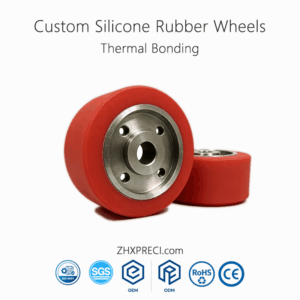
heat resistant silicone wheel for packaging system conveyor belt
Heat Resistant Silicone Wheel for Packaging System Conveyor Belt: Engineered for High-Temperature Reliability
When a packaging line runs heat sealing, shrink wrapping, or hot melt adhesive applications, standard conveyor wheels often soften, deform, or develop flat spots. This leads to product jams, uneven belt tracking, and unplanned downtime. A heat resistant silicone wheel for packaging system conveyor belt solves these problems by maintaining structural integrity and dimensional stability at elevated temperatures. Silicone’s unique elastomeric properties allow these wheels to operate continuously in environments where conventional rubber or polyurethane would fail, typically between -40°C and +260°C depending on the compound grade.
Why Choose Silicone Over Other Materials for Hot Conveyor Zones?
Many packaging systems include thermal tunnels, infrared heaters, or contact heat sealers that raise ambient temperatures around conveyor components. Standard wheels made from nitrile or natural rubber become brittle or sticky under such conditions. Heat resistant silicone wheels retain their resilience, surface smoothness, and load capacity without leaching plasticizers or generating harmful fumes. Additionally, silicone’s non-stick surface prevents melted adhesives or packaging residues from building up on the wheel face, reducing cleaning frequency and improving hygiene – a critical factor in food and pharmaceutical packaging lines.
Key Performance Advantages for Packaging Conveyor Systems
High thermal stability: Withstand continuous exposure to 200°C–260°C without losing hardness or shape, supporting high-speed packaging processes.
Low compression set: Silicone wheels recover quickly after repeated compression cycles, ensuring consistent belt tension and alignment.
Non-stick & easy release: Resists adhesion from hot melt glues, lidding films, and shrink wrap residues, minimising conveyor stoppages.
Quiet, smooth operation: Natural damping reduces noise compared to metal or hard polymer wheels, improving workstation comfort.
Chemical & ozone resistance: Ozone, UV, and common packaging line cleaning agents do not degrade silicone, extending wheel life.
Tailored Design for Conveyor Belt Integration
Not every packaging line uses the same belt profile or drive configuration. A proper heat resistant silicone wheel for packaging system conveyor belt must match specific dimensions, bore sizes, keyways, or set screw arrangements. Common design variations include flat face wheels for belt support, flanged wheels for lateral tracking, and grooved wheels for V-belts or timing belts. Tread patterns can be smooth, diamond knurled, or with custom ribs to enhance grip without damaging heat-sensitive belts. Axial play and radial runout are kept to strict tolerances (typically ISO 6–8) to prevent vibration in high-speed packaging equipment.
OEM/ODM Custom Elastomer Wheels from a Trusted Supplier
For packaging line builders and maintenance engineers, sourcing wheels that combine heat resistance with precise dimensions is often challenging. Industrial Rubber Wheels from ZHXPRECI | China OEM/ODM Factory Supplier Custom Elastomer Wheels & Rollers delivers engineered solutions for both silicone and specialized rubber wheels. ZHXPRECI offers full customization: shore hardness from 40 to 85 Shore A, different silicone bases (VMQ, FVMQ for fuel/oil exposure), colors for product differentiation, and integrated bearings or bushings. Their manufacturing process includes compression molding, injection molding, and precision CNC turning of cured wheels, ensuring batch-to-batch consistency. Every wheel can be supplied with certificates of material traceability, dimensional reports, and test data for thermal aging, providing verifiable documentation for regulated packaging environments.
Real-World Packaging Applications & Installation Best Practices
Typical installations for heat resistant silicone wheels include exit sections of shrink wrap tunnels, cooling conveyors after heat sealing, bottle cap induction sealers, and as drive wheels for mesh belts in food baking lines. When installing, avoid over-tightening bearings or set screws, as silicone is more tear-propagating than rubber. Use stainless steel hardware if washdown cleaning with aggressive chemicals is required. Inspect wheels every 1,000 operating hours for any surface cracking; under normal conditions, a quality silicone wheel will outlast other polymer wheels by 3–5 times in hot packaging environments.
Technical Compliance & Source Transparency
All specifications referenced here are consistent with widely accepted elastomer engineering data (ISO 48-2 hardness testing, ASTM D412 for tensile strength, and DIN 53508 for heat aging). For OEM buyers, ZHXPRECI provides full material datasheets and can validate wheel performance according to your specific temperature profile and load cycle. The company operates IATF 16949 and ISO 9001 certified processes, ensuring that Industrial Rubber Wheels from ZHXPRECI | China OEM/ODM Factory Supplier Custom Elastomer Wheels & Rollers meet international quality standards for export to North America, Europe, and Asia. Requesting free samples for conveyer belt compatibility tests is standard practice before volume orders.
In summary, selecting a heat resistant silicone wheel for packaging system conveyor belt directly improves line uptime, reduces roller replacement frequency, and keeps hygiene in high-temperature zones under control. With proper sizing and a reliable partner like ZHXPRECI, integrators can design conveyors that consistently run at elevated temperatures without unexpected wheel failures.
Showing the single result