
Custom PU Roller Wheels
Custom PU Roller Wheels – To Spec
Custom PU wheels for AGVs & conveyors. Engineered for load, hardness, temp & certs.
- 30-500kg load
- 60-95A Shore
- 60-300mm dia
- -30-+80°C temp
- ISO/REACH cert
Showing all 4 results
-
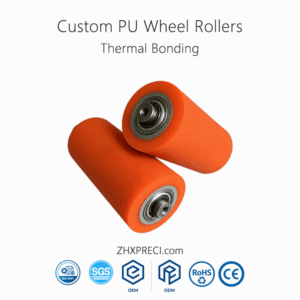
Custom Polyurethane Coated Wheel for Packaging Automation Systems – Wear Resistant, Oil Resistant, High Load Capacity, Low Noise
Read more -
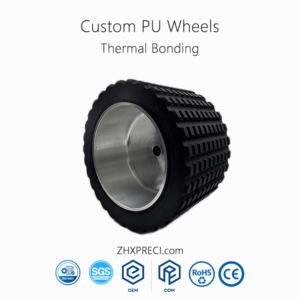
Custom Polyurethane Robot Walking Wheel – Heavy-Duty Wear-Resistant Load-Bearing Drive Roller for DIY Trolley
Read more -
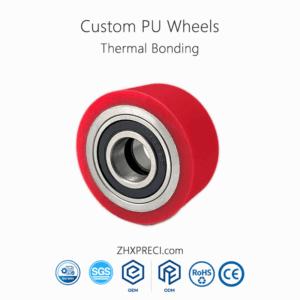
Custom Polyurethane Wheel for Factory Conveyor Systems & Industrial Conveyor Transport Polyurethane Coated Wheel
Read more -
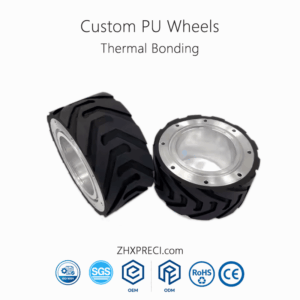
Custom PU Wheel Heavy Duty for Walking Robot & Trolley – Wear-Resistant, Non-Marking, Replacement for Rubber Rollers
Read more
Custom PU Roller Wheels: Engineering Overview for Industrial Buyers
In material handling, conveyor systems, automated guided vehicles (AGVs), and heavy-duty machinery, the selection of roller wheels directly influences operational efficiency, maintenance intervals, and total cost of ownership. This category focuses on polyurethane (PU) roller wheels engineered to order—where hardness, rebound, adhesion, and dimensional tolerances are adapted to specific track profiles, load spectra, and environmental conditions. Custom PU Roller Wheels from ZHXPRECI | China OEM/ODM Factory Manufacturer Supplier Custom Elastomer Wheels & Rollers represent a sourcing option that combines formulation flexibility with process repeatability, yet every technical decision requires a balanced evaluation of application demands and material capabilities.
What Defines a Custom PU Roller Wheel?
A custom PU roller wheel differs from off-the-shelf alternatives in three fundamental aspects: chemical formulation, geometric design, and interface integration. The polyurethane elastomer can be adjusted in hardness from 60 Shore A to 75 Shore D, with corresponding changes in tensile strength (typically 25–55 MPa) and elongation at break (250–650 %). The wheel diameter, tread profile (crowned, flat, grooved, or V-groove), hub material (aluminum, steel, or engineering plastic), and bearing type (ball, roller, or plain) are specified per drawing. This level of customization allows the wheel to match rail systems, floor surfaces, or track curvatures that standard products may not accommodate. For instance, a wheel intended for a high-speed sorting conveyor may require a lower rebound resilience (40–50 %) to dampen vibration, whereas a wheel for a washdown environment may need hydrolysis-resistant prepolymers.
How to Specify the Right PU Formulation for Your Application
The specification process begins with a load calculation: determine the static and dynamic loads per wheel, factoring in acceleration, braking, and side forces. Polyurethanes exhibit excellent load-bearing capacity, with compressive strength ranging from 20 to 120 N/mm² depending on the isocyanate and polyol system. However, the operating temperature range is equally critical—standard PU grades perform between -20 °C and +80 °C, while specialized formulations can extend to -40 °C or +120 °C with reduced mechanical properties. Chemical resistance: PU wheels show good resistance to oils, greases, and non-polar solvents, but are susceptible to strong acids, bases, and steam. Therefore, the specification document should include the expected exposure to cleaning agents, coolants, or UV radiation. Hardness selection directly affects floor wear and rolling resistance: softer wheels (80–90 Shore A) offer higher friction and quieter operation but may deform under heavy loads; harder wheels (95 Shore A to 55 Shore D) reduce rolling resistance and last longer on rough surfaces, yet transmit more vibration.
Key Technical Parameters and Their Practical Implications
- Tensile strength – reflects the material’s resistance to tear and fracture. Values above 40 MPa indicate a robust elastomer suitable for shock-loading applications.
- Tear resistance (DIN 53507) – typically measured in kN/m; a higher value (e.g., 80–120 kN/m) is desirable for wheels with thin tread sections or high edge loads.
- Abrasion loss (DIN 53516) – expressed in mm³; losses under 40 mm³ are considered excellent for continuous sliding or abrasive floors.
- Rebound resilience – influences energy return and heat buildup; values around 40–60 % offer a compromise between damping and efficiency.
- Compression set – lower percentages (below 20 % after 24 h at 70 °C) ensure the wheel retains its shape under sustained static loads.
These parameters are not guaranteed in isolation; they interact with the casting process (vulcanization or injection molding) and the bonding agent between the PU tread and the core. A well-designed custom wheel will balance these properties to match the actual duty cycle—for example, a warehouse AGV performing 1000 cycles per day with frequent starts and stops requires higher tear resistance and lower hysteresis than a gravity conveyor wheel.
Common Questions from Engineers and Procurement Specialists
What is the typical service life of a custom PU roller wheel?
Service life depends on the interplay of load, speed, floor condition, and maintenance. In moderate-duty logistics (loads under 500 kg per wheel, speeds below 1.5 m/s), a properly formulated PU wheel often exceeds 20,000 operating hours before a measurable tread loss of 3 mm. Heavy-duty steel mill applications may see replacement intervals of 6–12 months due to extreme temperatures and abrasive scales. Since each application is unique, we recommend conducting a prototype field trial under actual operating conditions to project life expectancy. The trial should include periodic hardness checks and visual inspections for chunking or delamination.
How does the choice of core material affect performance?
Aluminum cores offer lightweight and good thermal conductivity, which helps dissipate heat generated from hysteresis. Steel cores provide superior strength and are preferred for very high loads (over 1000 kg per wheel) or where mounting involves set screws or keyways. Plastic cores (e.g., polyamide or POM) reduce overall weight and resist corrosion but may creep under sustained heavy loads. The bond between the PU and the core must be chemically or mechanically reinforced; a silane-based primer and a suitable adhesive layer are standard practice to achieve a peel strength above 4 N/mm.
Can you provide a ballpark lead time for custom orders?
Lead time is subject to order quantity, current production schedule, and final specification confirmation. For a typical batch of 100 to 500 wheels, the engineering phase (drawing review, tooling preparation, and material compounding) may take 2–3 weeks, followed by molding and curing. Larger quantities or complex geometries with multiple durometer zones may require additional processing steps. We advise discussing your timeline early in the inquiry, so that we can align with available capacity and, if needed, propose a phased delivery approach.
What quality control measures are applied to custom PU wheels?
In-process inspections include Shore hardness verification on each batch, tensile and tear tests on witness samples, and dimensional checks using coordinate measuring machines. Finished wheels undergo a run-out test to ensure concentricity within 0.15 mm TIR, and a balance check for high-speed applications. A hydraulic press test confirms the wheel’s load rating under a 1.5× safety factor. All test records are retained for traceability. While no process can eliminate every micro-defect, these systematic checks reduce variability and provide objective data for acceptance decisions.
Material Selection Matrix for Typical Environments
| Environment | Recommended Hardness | Preferred PU Type | Core Suggestion |
|---|---|---|---|
| Clean indoor conveyor (dry, <40 °C) | 88–93 Shore A | Ester-based | Aluminum or plastic |
| Outdoor or wet conditions | 92–97 Shore A | Ether-based (hydrolysis-resistant) | Stainless steel |
| Oily workshop floors | 85–90 Shore A | Ester-based with oil-resistant additives | Steel with zinc plating |
| High-temperature drying kilns | 50–55 Shore D | Special high-temp prepolymer | Steel with heat shield |
This table serves as a general starting point; final selection should be verified through the supplier’s technical questionnaire.
Design Considerations for Mounting and Tread Profile
The mounting method—whether press-fit bearings, flanged hubs, or tapered bores—determines the wheel’s ease of replacement and axial stability. For AGV applications where steering is involved, a crowned tread (a slightly convex profile) helps the wheel self-center on the track, reducing flange wear. Grooved profiles are useful for cable-driven systems or to provide positive traction on slippery surfaces. When specifying the tread width, note that a wider tire distributes the load better, reducing floor pressure, but also increases rolling resistance on uneven floors. A rule of thumb: the tread width should be at least 1.2 times the wheel diameter for stability in mobile equipment.
Dynamic Performance: Rolling Resistance and Noise
Rolling resistance is a critical factor for battery-powered AGVs, as it directly affects energy consumption. The coefficient of rolling friction (CRF) for PU on steel is typically 0.02–0.06, depending on hardness and surface finish. Softer PU provides higher grip but increases CRF by about 30 % compared to hard PU. For noise reduction, a cellular PU formulation or a micro-cellular structure can absorb impact noise; however, this may reduce load capacity. We recommend evaluating the trade-off between energy efficiency and acoustic comfort, especially in indoor environments with strict noise limits.
Customization Process from Inquiry to Delivery
The typical workflow: (1) Submit a 2D/3D drawing or a detailed specification sheet including load, speed, operating temperature, and chemical exposure. (2) Our engineering team reviews the application, proposes a PU grade, and returns a preliminary design report with calculated safety factors. (3) Sample wheels (usually 2–5 pieces) are produced for functional testing—this phase is crucial for verifying fit and performance. (4) Upon sample approval, mass production commences with the confirmed compound and tooling. (5) Final inspection and packaging are customized to prevent transit damage. Throughout this process, communication is iterative; we encourage questions about material certificates (e.g., RoHS, REACH) or test methods.
Frequently Asked Questions on Cost and MOQ
What factors influence the unit price of custom PU wheels?
Price is driven by: compound complexity (special additives increase raw material cost), casting method (injection molding is more economical for high volumes, while hand-pouring suits small batches), core machining requirements, bearing precision grade, and finishing operations (e.g., balancing or coating). Tooling cost is amortized over the order quantity; larger orders dilute the tooling charge. We provide a transparent cost breakdown upon receiving the full specification, allowing you to compare options.
Is there a minimum order quantity?
For fully custom compounds, a minimum of 50 pieces is often practical to justify material blending and setup. For modifications to an existing standard wheel (e.g., different bore size), we can accommodate smaller quantities down to 10 pieces. Prototype samples are always welcomed and carry a separate cost structure. We do not impose rigid MOQ policies; instead, we discuss feasibility based on your project’s lifecycle and budget.
Compatibility with Vantage Theme and WooCommerce Integration
This descriptive content is designed to be embedded within the product category page of a WordPress site using the Vantage theme. The structured headings (H2, H3, H4) and clear paragraphing improve readability for both human visitors and search engine crawlers. The inclusion of a technical data table and FAQ-style sections addresses common search intents, such as “PU roller wheel hardness selection” or “custom roller wheel lead time”. Custom PU Roller Wheels from ZHXPRECI | China OEM/ODM Factory Manufacturer Supplier Custom Elastomer Wheels & Rollers is referenced organically within the narrative, reinforcing the source without disrupting the informational tone. For optimal SEO, we recommend adding schema markup (Product or ItemList) to the parent category, though that resides outside this HTML block.
Maintenance and Replacement Indicators
To maximize the operational reliability of PU wheels, establish a periodic inspection schedule: check for flat spots (caused by prolonged static loading), surface cracking (ozone or UV attack), and bearing smoothness. A durometer reading that deviates more than ±5 points from the original specification may indicate material degradation. Replace wheels when the tread wears down to 80 % of its original thickness, or when any visible chunking occurs. Proper storage—away from direct sunlight, ozone sources, and high humidity—extends shelf life. These practices are standard in industrial maintenance and contribute to predictable performance.
Conclusion: Making an Informed Decision
Custom PU roller wheels offer a tailored solution for demanding motion systems, but their success hinges on thorough application analysis and realistic expectations. By focusing on measurable parameters—load, speed, environment, and durability targets—you can define a specification that aligns with your performance goals. Engage with suppliers who share test data and previous case studies, and always validate with prototypes. The information provided here serves as a technical foundation; for project-specific advice, consult with application engineers who can run FEA simulations or accelerated life tests. Remember that material science is an evolving field, and new prepolymer systems are continuously developed to address emerging requirements such as static-dissipative or food-contact grades.