


Description
Custom High Temperature Polyurethane Wheels for Oven Trolleys – Heat-Stabilised PU Tread, Steel Core, Continuous Service up to 130°C, 100–250 mm Diameter, Load up to 800 kg per Wheel
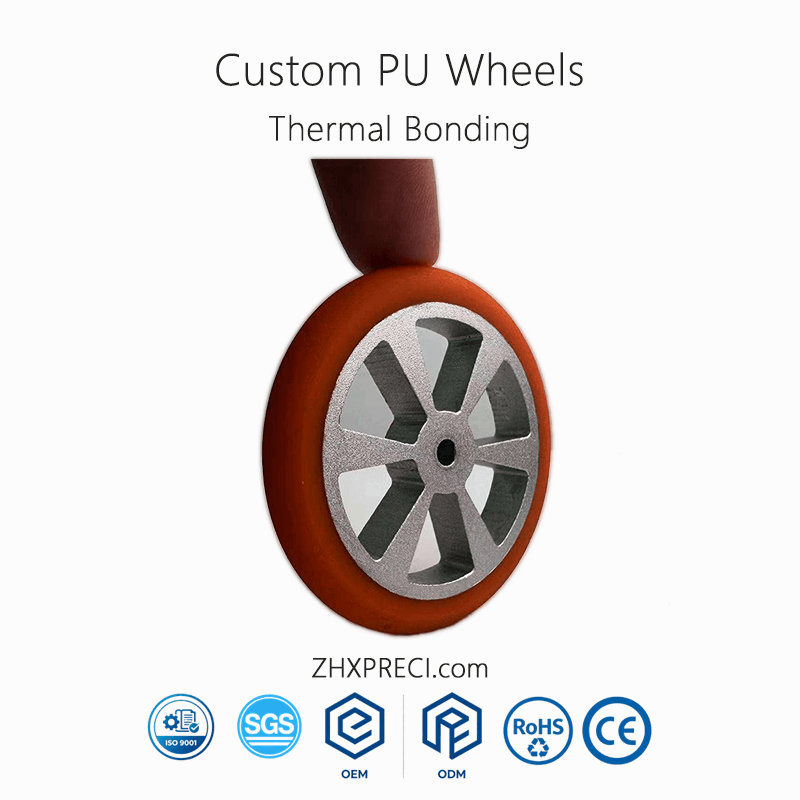
Our custom high temperature polyurethane wheels for oven trolleys are cast in our own factory in China from a heat-stabilised polyurethane compound rather than a generic off-the-shelf elastomer. Each wheel pairs a Shore A 90 ± 3 tread with a machined cast iron, aluminium or stainless steel core, so it keeps its elasticity and rebound in continuous service up to 130°C, while ordinary rubber and nylon wheels soften, harden or flat-spot under the same load. For bakery, confectionery and industrial oven operators, that means trolleys keep rolling smoothly through repeated bake cycles, with fewer wheel replacements, less track damage and lower unplanned downtime. Every production batch is verified with loaded rolling tests and supported by an ISO 9001 quality system, and as a direct manufacturer we offer wholesale pricing together with full customization of diameter, tread width, hardness, bore and bearing to match your trolley drawing.
Why choose our custom high temperature polyurethane oven trolley wheels?
Oven trolley wheels rarely fail because of a single bad batch. They fail because a wheel was selected for room temperature and then pushed into a hot baking tunnel, or because a supplier offered a stock size that almost fitted the trolley frame. We work the other way round: you send us the trolley drawing, the load per wheel, the running temperature and the track profile, and our engineers recommend the tread hardness, diameter, bore and bearing that will actually last in that position.
The heat-stabilised polyurethane tread is formulated to hold its elasticity and rebound up to 130°C, instead of hardening and cracking like standard polyurethane. Cast iron, aluminium and stainless steel cores are machined and bonded so the tread will not separate under heavy vertical load or side thrust. The smooth, non-marking surface leaves no black scuff marks on oven floors or conveyor tracks and runs noticeably quieter than hard nylon or steel. Dynamic concentricity checks and loaded rolling tests on each batch keep the running quality consistent, and full customization of size, hardness, bore, hub length, bearing and colour is available for OEM and ODM projects.
Typical applications: bakery and confectionery oven trolleys, industrial baking tunnels, proofing and cooling racks, conveyor tracks in food processing plants, heavy-load transfer trolleys, and wash-down areas where non-marking, low-noise rolling matters.
As a China-based factory and OEM/ODM supplier, we produce custom high temperature polyurethane wheels to your drawing, with your choice of diameter, tread width, hardness, core material and bearing. Wholesale orders and customized trial batches are welcome for oven builders and material handling projects worldwide.
Technical Specifications – Custom High Temperature Polyurethane Oven Trolley Wheels
The table below lists our typical build range for custom high temperature polyurethane oven trolley wheels. As a China OEM/ODM manufacturer, we treat every value as a starting point and adjust size, hardness and core material to suit your customized trolley design and working conditions.
| Standard High Temperature PU Oven Trolley Wheel – 150 mm Diameter, Steel Core, Shore A 90 (Customizable) | |
|---|---|
| Product type | Custom high temperature polyurethane wheel for oven trolleys |
| Wheel diameter | 100 mm to 250 mm, produced to your drawing |
| Tread width | 30 mm to 60 mm |
| Tread material | Heat-stabilised polyurethane, non-marking finish |
| Tread hardness | Shore A 85 to 95, selected according to load and temperature |
| Wheel core | Cast iron, aluminium or stainless steel |
| Bearing options | Precision ball bearing, stainless steel bearing or plain bore |
| Working temperature | Continuous service up to 130°C |
| Load capacity | Up to 800 kg per wheel, depending on diameter and core type |
| Customization | Size, hardness, bore, hub length, bearing and colour |
| Quality system | ISO 9001 certified production with batch testing |
| Minimum order quantity | 50 pieces per size, with trial quantities available on request |
| Lead time | Typically 15 to 25 days after order confirmation, subject to material supply and production schedule |
Suitable for bakery ovens, baking tunnels, proofing racks and conveyor tracks. The heat-stabilised polyurethane compound resists oven heat, workshop oils and cleaning agents. These wheels are for sale in bulk and wholesale quantities, and our team is glad to give expert advice on hardness selection before you place an order.
Details Images – Construction and Application


Material and Performance Properties of the Heat-Stabilised PU Tread
| Property | Behaviour in Oven Trolley Service |
|---|---|
| Heat resistance | Retains elasticity and rebound in continuous service up to 130°C |
| Abrasion resistance | Keeps its tread profile and diameter well after conventional rubber begins to wear thin |
| Compression set | Low, so wheels resist flat spotting when trolleys stand loaded in a hot oven |
| Load bearing | High load capacity with a metal core that prevents hub deformation |
| Oil and grease resistance | Good resistance to common workshop oils, greases and cleaning agents |
| Rolling noise | Low noise on steel, concrete and track floors compared with hard nylon or steel wheels |
| Floor protection | Non-marking smooth tread that protects coated floors and conveyor surfaces |
These are the properties our customers ask about most often, because they decide whether a wheel lasts one season or several years. For unusual temperature loads, aggressive chemicals or very tight tolerances, our technical team will confirm feasibility before production rather than promise something we cannot deliver.
Wheel Material Comparison – Choosing the Right Compound for Oven Trolleys
| Wheel Material | Hardness Range | Heat Resistance | Abrasion Resistance | Load Bearing |
|---|---|---|---|---|
| Heat-stabilised polyurethane, as used in this wheel | Shore A 85–95 | Excellent, stable to 130°C | Excellent | Excellent |
| Standard polyurethane | Shore A 80–95 | Fair, softens early | Very good | Very good |
| Nylon | Shore D 75–85 | Poor, flat spots under heat | Good | Good |
| Rubber | Shore A 50–80 | Poor | Fair | Fair |
| Silicone | Shore A 40–90 | Good in the mid range | Fair | Fair |
This comparison reflects typical behaviour in oven trolley service rather than a laboratory ranking. For high temperature positions, the heat-stabilised polyurethane tread is our standard recommendation; where surfaces are delicate or the ambient temperature sits in a mid range, our custom non-marking silicone coated wheels are often the better fit. Wholesale pricing and customized hardness selection are available directly from our factory.
About Us – China OEM/ODM Manufacturer of High Temperature Polyurethane Wheels
Our Factory Overview

Customers Visiting

Thank you for visiting. We are a China-based manufacturer specializing in custom polyurethane and silicone wheels, rollers and casters for industrial equipment, serving oven builders, conveyor integrators and material handling suppliers in more than twenty countries. Our factory combines casting, machining, bonding and assembly under one roof, which is why we can accept customized orders that many trading companies have to turn away, and why our wholesale pricing stays stable for repeat buyers.
Over the years we have learned that the real problems in this market are rarely about price alone. Customers struggle with wheels that fail too early, drawings that get lost between supplier and factory, delivery dates that move without explanation and hidden costs that appear only after the order is placed. We try to close those gaps by keeping engineering and production in the same building, by confirming specifications in writing before tooling starts, and by telling you honestly when a request falls outside what we can reliably produce. Most common materials and processes are well within our normal range, but for unusual temperature loads, aggressive chemicals or very tight tolerances we always ask our technical team to confirm feasibility first. That is also our suggestion for your own project: send the drawing and the working conditions, and let us give you a professional assessment and a realistic price suggestion before you commit to a full order.
Visits from Europe, North America, Southeast Asia and the Middle East
A typical visit starts with a walk through the casting and machining areas, followed by a review of the drawings and working conditions for the project in question, and often ends with a discussion about samples and trial orders. Seeing the machines and the inspection process in person tends to settle the questions that email cannot answer, and we are glad to arrange visits or online factory tours whenever it helps you make a decision.
Factory and Equipment
Temperature-Controlled Casting, CNC Machining, Controlled Bonding and Load Testing Under One Roof


Our production line covers the full sequence from mould preparation to final inspection. PU casting and curing are carried out in temperature-controlled stations, cores are machined on CNC lathes to keep bore tolerances consistent, and tread bonding is done under controlled pressure so the bond survives repeated heat cycling. After curing, wheels are trimmed, ground where required, fitted with bearings and checked one by one for concentricity and free rotation. Because we control these steps ourselves, we can adjust hardness or core design between batches without waiting for an outside workshop, which shortens the cycle for customized orders and keeps wholesale pricing predictable for regular buyers.
Quality Control and Certifications
Quality control runs through the whole order rather than sitting at the end. Incoming raw materials are checked before casting, samples are taken during each production batch, and finished wheels go through dimensional inspection, hardness testing and loaded rolling checks. Where a customer requires it, we also support third-party inspection before shipment.
- ISO 9001 certified production system
- Batch hardness and dimensional inspection records
- Loaded rolling test on newly developed compounds
- ROHS-compliant raw materials on request
- Third-party inspection welcomed at any stage of production


Production and Inventory Policy
Lead time: Actual lead time is influenced by raw material supply, machine scheduling, peak season workload and other factors, so it can fluctuate within a reasonable range. Once your order is confirmed, we will provide the most accurate delivery estimate we can and keep you updated throughout production.
Stock status: We do not hold stock as a rule, although a limited number of fast-moving standard sizes are kept on hand. The actual quantity available changes constantly with sales and production, so we recommend contacting our team to confirm live stock before placing an order.
Bulk and urgent orders: For large volume orders or urgent requirements, please talk to us in advance about capacity and scheduling. We will do our best to fit your timeline and will always tell you clearly if a date cannot be met.
Frequently Asked Questions – Custom High Temperature Polyurethane Oven Trolley Wheels
1. What makes these wheels suitable for high temperature oven trolleys?
The tread is cast from a heat-stabilised polyurethane compound rather than a standard PU, so it keeps its elasticity and rebound in continuous service up to 130°C. Standard polyurethane or rubber tends to harden and flat-spot at those temperatures, which is what causes trolleys to seize on the track and wheels to crack around the hub.
2. How does your heat-stabilised polyurethane compare with standard PU or rubber at 130°C?
In our material comparison table, the heat-stabilised compound is the only option rated excellent on both heat resistance and load bearing. Standard PU softens earlier and rubber loses its rebound, so both tend to develop flat spots when a loaded trolley stands still in a hot oven. We confirm the expected behaviour with loaded rolling tests on each production batch before shipping.
3. Can you customize the wheel size, hardness and bore for our trolley design?
Yes. Diameter, tread width, Shore A hardness, bore size, hub length, bearing type and colour can all be produced to your drawing or sample. If you are unsure which hardness suits your load and running temperature, our engineers will give you a recommendation based on the working conditions you describe.
4. What is your minimum order quantity, and can I order a small trial batch?
Our standard minimum is 50 pieces per size, but trial quantities are available on request for new projects and first-time orders. Many of our long-term wholesale customers started with a small trial run to verify the wheel performance on their own ovens before committing to volume orders.
5. How do you control quality, and what certifications do you hold?
Production runs under an ISO 9001 quality system. Incoming materials are checked before casting, each batch is sampled for hardness and dimensions, and finished wheels are inspected for concentricity and free rotation. Third-party inspection before shipment is always welcome if your purchasing process requires it.
6. How long is the lead time, and how are the wheels packed?
Typical production time is 15 to 25 days after order confirmation, though this can shift with material supply and seasonal workload. Wheels are usually packed in cartons on pallets, with the option of individual wrapping or custom carton printing for OEM orders.
7. Do you offer wholesale pricing for repeat or bulk orders?
As a direct manufacturer rather than a trading company, we quote from our own moulding and machining lines, which keeps pricing stable for repeat orders. For volume quantities, share your annual or per-order target and we will prepare a tailored quotation.
8. Do you also supply non-marking silicone coated wheels and smooth conveyor rollers?
Yes. We manufacture custom non-marking silicone coated wheels and smooth conveyor rollers alongside our high temperature polyurethane range, so a project that needs several wheel types can be produced and inspected under one order. Silicone coated wheels usually suit delicate surfaces or mid-range temperatures, while smooth conveyor rollers are chosen where the load is uniform and quiet running matters more than shock absorption.
9. What payment and shipping methods do you accept?
We normally work with T/T and other terms agreed at order stage. For shipping we can arrange sea freight, air freight or express courier depending on order volume and urgency, and we will quote the option that best fits your market and budget.
10. Do you offer OEM, ODM and private label service?
Yes. We support OEM and ODM projects, including custom moulds, private label printing and dedicated packaging. If you need a wheel that does not currently exist in your market, send us the drawing or the failing sample and we will advise on a practical production route.
Looking for a reliable manufacturing partner for high temperature oven trolley wheels?
Send us your wheel size, load per wheel and running temperature, and our engineers will come back with a custom solution, a quick quotation and sample advice. We are happy to support your project from drawing review to final delivery.
Reviews
There are no reviews yet.