


Description
Custom Bolt On Polyurethane Wheels for Utility Trailers
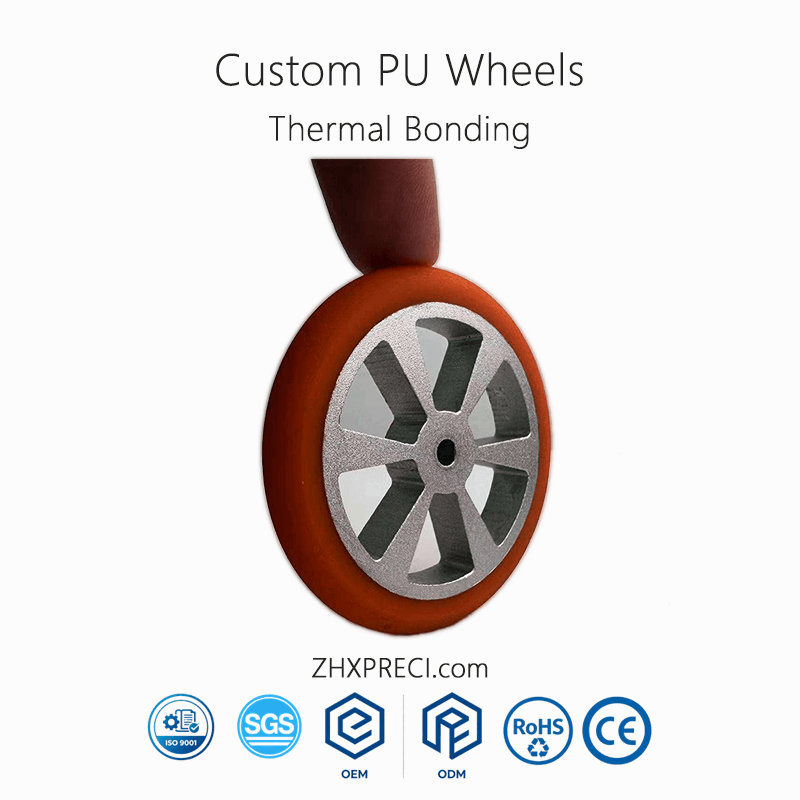
Our custom bolt on polyurethane wheels for utility trailers are built on a machined steel or cast iron core with a virgin MDI-based polyurethane tread bonded directly to it, so they keep their shape and roundness long after rubber and plastic wheels have started to flat-spot. Because the tread is chemically bonded rather than press-fitted, these wheels tolerate repeated highway towing, curb strikes and heavy yard loads without de-bonding, which means your trailers roll straighter and your service team replaces far fewer wheels each season. Every wheel is machined to your bore size, bolt circle, offset and hub length, giving you a true bolt-on fit with no adapters and no rework on the assembly line. We are a China-based manufacturer running OEM, ODM and OBM programs for trailer builders, rental fleets and aftermarket wholesalers, and we quote factory-direct prices rather than trading-company margins. Each production lot is checked for hardness, concentricity and bond integrity on our ISO 9001-aligned quality line before it ships.
Why Choose Our Custom Bolt On Polyurethane Wheels
Most utility trailers leave the factory with rubber or nylon wheels that are cheap to buy and expensive to own: rubber tears and flat-spots under standing load, while nylon is hard, loud and unforgiving on rough pavement. Our polyurethane tread sits between the two, delivering the abrasion resistance of a hard compound with enough resilience to absorb road shock, typically lasting several times longer than the same-size rubber wheel in towing service. The rebound keeps the wheel in contact with the ground instead of bouncing, which protects your trailer frame, your cargo and your tow vehicle.
- Tread compound: virgin MDI-based polyurethane, Shore A 85 to 95, selected for your load and speed range.
- Core: welded or cast steel hub with baked enamel or zinc plating, machined for concentricity.
- Bearing choice: precision tapered roller bearings, sealed ball bearings or plain bore, matched to your duty cycle.
- Custom fit: bore diameter, bolt pattern, hub length and offset produced to your drawing or sample.
- Load range: standard wheels rated 300 to 1200 lb per wheel depending on size and bearing type.
Specifications – Bolt On Polyurethane Utility Trailer Wheels
The table below lists our standard reference range, covering the sizes most often ordered by trailer builders. These wheels are for sale in both standard reference sizes and fully custom configurations. Because every trailer program is different, we produce them to order, and your drawing takes priority over any value listed here. Send us your bore size, bolt circle and load requirement, and our engineering team will confirm feasible dimensions before you commit to a purchase order.
| Parameter | Standard Reference Range | Customization Available |
|---|---|---|
| Wheel diameter | 203 mm / 254 mm / 305 mm (8 in, 10 in, 12 in) | Yes, intermediate diameters on request |
| Tread width | 51 mm to 76 mm (2 in to 3 in) | Yes, wider tread for soft ground |
| Tread material | Virgin MDI-based polyurethane | Color and compound grade selectable |
| Tread hardness | Shore A 85 to 95 | Softer or harder compound for specific use |
| Core material | Steel or cast iron hub | Machined to drawing with keyway if required |
| Bore and bolt pattern | 20 mm bore, 4 on 101.6 mm bolt circle as reference | Any bore, bolt circle, offset or hub length |
| Bearing type | Tapered roller, sealed ball or plain bore | Matched to load and speed requirement |
| Load capacity | 300 lb to 1200 lb per wheel (approx. 136 kg to 545 kg) | Higher ratings with larger hub and bearing |
| Surface finish | Zinc plated or powder coated hub | Color matching to your brand |
| Operating temperature | -20 °C to +80 °C | Higher temperature grades under review with our engineers |
Details Images – Construction & Application


Material Properties
The numbers below come from our routine in-house testing of the standard Shore A 90 compound used on most utility trailer wheels. They are typical values, not guaranteed minimums, because the exact behavior of a wheel depends on load, speed, surface and temperature in your application. If your trailer runs continuously at high load, tell us and we will recommend a compound and hub combination that fits that duty cycle.
| Property | Typical Value | What It Means in Real Use |
|---|---|---|
| Hardness | Shore A 90 | Firm enough to resist flat-spotting under a parked trailer, soft enough to absorb road shock. |
| Abrasion resistance | Noticeably better than rubber in our drum test | Longer tread life on asphalt and gravel, fewer wheel changes per season. |
| Tensile strength | Around 35 MPa | Resists tearing when the wheel meets a curb or a pothole edge. |
| Rebound resilience | Moderate to good | Keeps the wheel tracking on the road instead of bouncing, protecting cargo. |
| Compression set | Low under rated load | Trailer can sit loaded for weeks without developing a permanent flat spot. |
| Oil and chemical resistance | Good against common oils, greases and mild solvents | Suitable for workshop, yard and roadside environments. |
| Bond strength | Chemical bond between tread and core | No separation under shock loading, unlike press-fit assemblies. |
| Dynamic balance | Controlled during machining | Reduces vibration at towing speed and extends bearing life. |
Quality Control and Certifications
Wheel failures usually trace back to two causes: inconsistent compound and poor bonding. We address both with incoming material inspection, controlled curing cycles and a pull test on a sample from every batch. Hubs are checked for bore tolerance and concentricity before assembly, and finished wheels are inspected for tread hardness and runout.
- ISO 9001-aligned quality management procedures across production.
- Batch records kept for compound mix, cure time and inspection results.
- Third-party inspection accepted at your request before shipment.
- Material certificates available for the polyurethane and hub steel.
Production and Inventory Policy
Lead time: Actual lead time depends on raw material supply, machining capacity and peak-season workload, so it varies from order to order. Once your order is confirmed we provide the most accurate delivery estimate we can and keep you updated if anything changes.
Stock status: We generally do not hold stock, though a small number of fast-moving standard sizes may be available. Any stock quantity changes daily with sales and production, so please contact us to confirm real-time availability before placing an order.
Bulk and urgent orders: For large volumes or tight deadlines, talk to us early about capacity and scheduling. We will do our best to fit your timeline.
About Us
We are a professional wheel and caster manufacturer based in China, supplying polyurethane, rubber and solid wheels to trailer builders, material handling distributors and industrial buyers worldwide. Our production covers machining, polyurethane casting and bonding, hub welding, finishing and assembly under one roof, which keeps lead times shorter and quality feedback faster than sourcing from multiple subcontractors. We work with customers in North America, Europe, Australia and the Middle East, and we are comfortable communicating in technical drawings, tolerance tables and English-language documentation.
Our team has spent more than a decade solving wheel problems for trailer and equipment builders, from flat-spotting complaints to bearing failures in dusty yards. That experience is what allows us to give you practical advice on hardness, hub design and bearing selection rather than simply quoting a part number. If your current supplier cannot match a custom bolt pattern or will not adjust the compound for your application, send us the details and we will tell you honestly whether we can help and what it would cost.
Our Factory Premises

Customers Visiting

Factory & Equipment


Our Certifications (ISO9001, RoHS, Testing Reports)

Frequently Asked Questions – Bolt On Polyurethane Trailer Wheels
What sizes and bolt patterns can you customize for these bolt on polyurethane wheels?
We machine hubs to your drawing or sample, so bore diameter, bolt circle, hub length, offset and keyway are all open to customization. The diameters listed in the specifications table are our common reference sizes, but intermediate diameters and wider treads are possible. Send us a sketch with the key dimensions and we will confirm what we can produce before you order.
What is the minimum order quantity for custom wheels?
MOQ depends on how far the wheel deviates from our standard range. For a new hub die or a fully custom bore and bolt pattern, the usual starting point is a few hundred pieces per size. For existing tooling, smaller trial orders can sometimes be arranged so you can test the wheel on a real trailer before committing to volume.
How do you price these wheels, and can you supply wholesale quantities?
Price is quoted per specification, because tread compound, hub material, bearing type and order quantity all affect cost. As a factory-direct manufacturer in China we price against your target market rather than a fixed catalog number, and we are glad to provide a wholesale price breakdown for larger annual volumes. Tell us your expected yearly usage and we will structure the quote around it.
Which polyurethane hardness should I choose for a utility trailer?
For general towing at moderate load, Shore A 90 works well: it resists flat-spotting but still absorbs road shock. If your trailers sit loaded for long periods, a slightly harder compound such as Shore A 95 reduces compression set. If the wheels are used on rough gravel or in cold weather, a softer compound around Shore A 85 gives better grip and impact resistance. Our team will recommend a grade once we know your load, speed and surface conditions.
How do you control quality and what certifications do you provide?
We run ISO 9001-aligned quality procedures covering incoming steel and polyurethane inspection, controlled curing, bond pull testing and final checks on hardness, bore tolerance and runout. Batch records are kept for traceability. Material certificates can be provided with the shipment, and third-party inspection is welcome if your buyer requires it.
What is the typical delivery time for a production order?
Delivery time depends on order quantity, tooling status and production scheduling at the time of confirmation. Once your order is placed we issue a delivery estimate and update you if raw material supply or capacity affects it. For urgent programs, discuss the deadline with us early so we can plan capacity around it.
What payment methods and shipping options do you accept?
We commonly work with T/T and other terms agreed at contract stage, and we can discuss the arrangement that suits your purchasing process. Shipping can be arranged by sea, air or express depending on volume and urgency, and we can ship to your nominated forwarder or a port of your choice.
Do you offer any warranty on these wheels?
We stand behind our workmanship and will replace or credit any wheel that fails because of a bonding or manufacturing defect within the agreed warranty period. Tread wear, overloading and bearing damage from improper installation are not covered, since they depend on how the wheel is used. We will always review a claim fairly and give you an honest assessment.
Get a Quote for Your Trailer Wheel Program
Looking for a reliable manufacturing partner for custom bolt on polyurethane wheels? Send us your drawing, load requirement or a sample wheel, and our team will come back with a practical recommendation, a factory-direct price and a realistic lead time. Custom samples and volume pricing are available for qualified trailer and equipment programs, and we are glad to share expert advice on the best wheel solution for your market.
Reviews
There are no reviews yet.