


Description
Custom Weld-On Polyurethane Wheels for Log Splitters
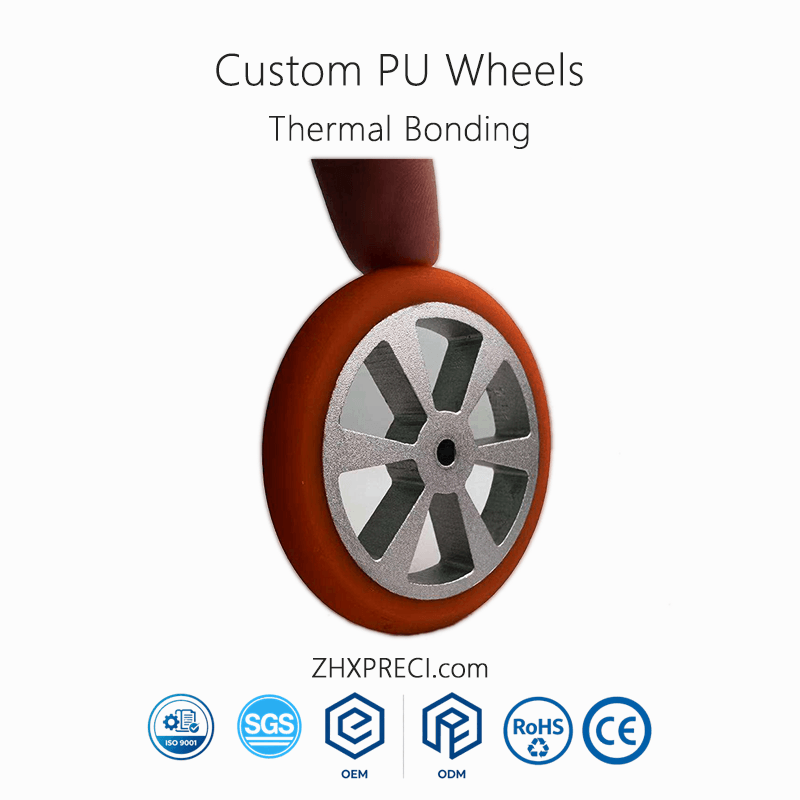
Our custom weld-on polyurethane wheels for log splitters are built for equipment builders, importers and OEM/ODM buyers who need a wheel that keeps rolling after years of gravel yards, wet grass and long outdoor storage. The tread is cast from polyurethane and bonded to a machined steel hub that you weld straight onto the splitter beam or axle, so there is no bracket to bolt on, no loose fasteners, and no wobble to chase after a season of work. Compared with the rubber wheels usually fitted to log splitters, the polyurethane tread resists cutting from bark, stone and workshop debris, holds its roundness under standing load, and rolls easier over rough ground, which means less pushing effort for the operator. Every batch comes out of our own China factory on ISO9001-controlled lines, with hardness, bonding strength and concentricity checked before packing, and we handle customization for OEM and ODM programmes including hub bore, weld pattern, wheel diameter, tread width and colour. Because we sell factory direct, these units are for sale at wholesale price levels that a trading company can rarely match, and our engineers will give you honest advice on the hardness and hub thickness that suits your market.
Why Choose These Weld-On Polyurethane Wheels
These wheels start life as a machined steel hub, turned to your weld pattern and wall thickness, and are then bonded to a polyurethane tread cast at Shore A 90±3. That combination cuts rolling resistance noticeably compared with a solid rubber tyre of the same size, while keeping the load path short and stiff, so the splitter stays stable when a heavy round is rolled onto the beam. For the operator this shows up as a machine that rolls out of the shed with one hand, tracks straight across a gravel drive, and resists flat spotting when it stands loaded for weeks at a time. We back that up with in-house testing on every production lot and an ISO9001 quality system that also covers small repeat and repair runs, and we are happy to supply batch records and peel test results with your order.
- Machined steel weld-on hub, available in 6 mm, 8 mm and 10 mm wall thickness
- Polyurethane tread in Shore A 85, 90 or 95 to match your load and ground conditions
- Concentricity held to ≤0.5 mm to limit vibration and uneven wear
- Bonding peel strength tested on each batch to catch weak joints before shipping
- Black as standard, with custom batch colours for OEM branding programmes
Specifications
The table below lists the standard range we build most often for custom weld-on polyurethane wheels for log splitters. Anything outside these figures is usually still possible as a custom solution, so send us your drawing and we will come back with wholesale pricing and a realistic lead time estimate for your market.
| Parameter | Standard Offering | Notes |
|---|---|---|
| Wheel outer diameter | 200 mm / 250 mm / 300 mm (8" / 10" / 12") | Custom sizes up to 400 mm on request |
| Tread width | 50 mm / 65 mm / 75 mm | Matched to your splitter beam or axle width |
| Tread material | Polyurethane, Shore A 90±3 | Shore A 85 or 95 available as a custom option |
| Hub type | Machined steel weld-on hub | Turned to your weld pattern and fillet requirement |
| Hub wall thickness | 6 mm / 8 mm / 10 mm | Selected against your load case and welding method |
| Load capacity per wheel | 150 kg / 250 kg / 350 kg | Measured at 8 km/h on a flat concrete floor |
| Concentricity | ≤0.5 mm | Checked on every production lot |
| Tread colour | Black | Orange, red or custom colour for OEM orders |
| Export packing | Carton on pallet, 20–60 pcs per carton | Rust protection applied to bare steel hubs |
Material Properties
The figures below are typical values from our routine batch testing, not guaranteed minimums for every application. If your log splitter runs in extreme cold, on abrasive ground, or under a load case we have not covered before, our technical team will give you an honest recommendation on hardness and hub thickness, along with price advice and a material suggestion based on your real operating conditions.
| Property | Typical Value | Test Reference |
|---|---|---|
| Hardness | Shore A 90 ± 3 | ASTM D2240 |
| Tensile strength | ≥ 35 MPa | ASTM D412 |
| Tear strength | ≥ 70 kN/m | ASTM D624 |
| Abrasion loss | ≤ 60 mm³ | DIN 53516 |
| Rebound resilience | ≥ 40% | ASTM D2632 |
| Compression set | ≤ 25% after 22 h at 70 °C | ASTM D395 |
| Bonding peel strength | ≥ 6 N/mm | In-house peel test |
| Service temperature | −30 °C to +80 °C | Continuous use |
Questions about how a specific hardness behaves under sustained load? Send us your working conditions and we will share test data from comparable jobs rather than a generic answer.
Customization Options
Most of our log splitter wheel business is customized work, and we are set up for both OEM and ODM projects with drawings, samples or simply a photo and a few measurements.
- Hub bore, weld pattern, chamfer and wall thickness to your drawing
- Wheel diameter and tread width outside our standard range
- Hardness selection from Shore A 80 to 95 for different ground and load conditions
- Tread profile changes, including rounded edge and crowned options
- Colour matching and moulded branding for OEM programmes
- Small trial runs before a full production order
Product Details Worth Checking
Before you approve a drawing, these are the four points that decide whether a weld-on wheel lasts or fails early.
- Weld area preparation: the hub lip is machined flat and clean, so your welder gets a consistent fillet without porosity traps.
- Bonding interface: the steel surface is prepared and primed before casting, which is what keeps the polyurethane from lifting at the tread edge.
- Tread shoulder radius: a controlled shoulder radius reduces tearing when the wheel is pushed sideways over kerbs and stones.
- Bare steel protection: unmachined areas receive a rust-preventive coat for container shipping, since a rusty hub is the first thing a customer notices on arrival.
Detailed photographs, dimensional drawings and hub close-ups are available on request so your engineering team can verify the design before ordering.
Details Images
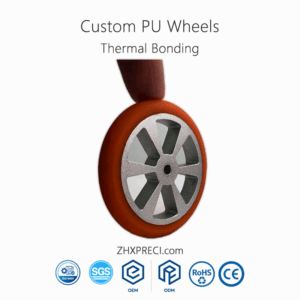
The photographs below show the polyurethane tread surface, the machined hub and the coated wheel body from our production line. If you want pictures of a specific hub bore or weld lip before ordering, just ask and we will send them the same working day.


About Us
We are a China-based manufacturer and supplier of polyurethane wheels and rollers, working mainly with equipment builders, wholesalers and importers rather than end users. Our team has been in the polyurethane casting and steel machining trade for over a decade, and log splitter wheels, caster wheels and industrial rollers form the core of what we produce. Because we sell factory direct, our units are for sale at wholesale price levels that a trading company cannot easily match, and every order is handled by the same engineers who set up the tooling. We keep a professional but straightforward approach: honest lead time estimates, clear price advice, and a real person answering your emails. If you are comparing suppliers, we would rather send you a sample and let the wheel speak for itself than fill a page with claims.

Customers Visiting

Factory & Equipment
Our workshop covers polyurethane mixing and casting, CNC turning, welding and finishing under one roof, which keeps quality control close to production and shortens the feedback loop when a tolerance drifts.
- Vacuum mixing and metering equipment for consistent polyurethane batches
- CNC turning centres for hubs, bores and weld lips
- Moulds for standard diameters plus tooling capacity for custom sizes
- Durometer, tensile and abrasion testing benches on site
- Concentricity and balancing checks before packing
- Dedicated packing area for export cartons and pallets
We handle OEM, ODM and OBM style cooperation, so whether you need parts under your own brand or a design developed together from a sketch, the process works from the same production floor.


Certifications & Compliance
Our quality system is built around ISO9001 procedures, and the materials we use are selected to meet RoHS and REACH requirements for export markets. Certificates, material declarations and batch test reports can be supplied with your shipment on request. If your market has a specific documentation requirement, tell us early and we will confirm what we can provide before the order is placed.


Production & Inventory Policy
Lead time: Actual lead time is affected by raw material supply, machining capacity and peak season workload, so it does vary. Once your order is confirmed we will give you the most accurate delivery estimate we can and keep you updated if anything changes.
Stock status: We generally do not hold stock, although a limited number of fast-moving standard sizes are kept on the shelf. Those stock quantities change with sales and production, so please contact us to confirm live availability before placing an order.
Bulk & urgent orders: For large volumes or tight deadlines, talk to us early about capacity and scheduling. We will do our best to fit your timeline and will tell you honestly if we cannot.
Frequently Asked Questions
What makes polyurethane better than rubber for log splitter wheels?
Rubber is soft and grips well, but it deforms under standing load and tends to flat spot when a splitter sits in a shed for months. Our custom weld-on polyurethane wheels for log splitters use a harder tread that holds its shape, resists cutting from bark and stone, and rolls with less effort on gravel. The trade-off is slightly less grip on wet smooth surfaces, which is rarely an issue on the yards and driveways where splitters are normally used.
Can you make wheels to my own hub drawing or weld pattern?
Yes. Send a drawing, a sample or even a photo with key measurements, and we will confirm feasibility, suggest any tolerance adjustments, and quote. Hub bore, weld lip, wall thickness and tread width are all made to your specification, which is why most of our wheel business is custom work rather than catalogue items.
Which wheel sizes and load ratings do you build most often for log splitters?
The common sizes are 200 mm, 250 mm and 300 mm diameter with a 50 to 75 mm tread width, covering roughly 150 kg to 350 kg per wheel on a flat floor. Larger diameters up to 400 mm are possible. If your splitter carries an unusual load or runs on very soft ground, tell us the details and we will recommend a size and hardness combination instead of simply quoting the closest standard part.
What is the minimum order quantity?
For standard sizes the MOQ is normally 100 pieces, and for fully custom hubs or new tooling it is usually 300 pieces. Smaller trial quantities can sometimes be arranged, especially when a new design needs to be tested on a real machine before a volume order. Ask us and we will find a workable starting point.
How are the wheels packed for export?
Wheels are packed in cartons on pallets, typically 20 to 60 pieces per carton depending on diameter, with rust-preventive treatment on bare steel surfaces. Cartons are labelled to your requirements, and we can arrange pallet dimensions to suit standard container loading if you tell us the destination port in advance.
Can I get a sample before placing a bulk order?
Yes. Sample orders are welcome, and for custom designs we can usually produce a prototype from your drawing. Sample cost and freight are normally charged, but we will discuss crediting part of it against a later volume order.
What payment methods do you accept?
We typically work on a 30% deposit with the balance against the bill of lading copy, by T/T. Other arrangements can be discussed for repeat customers or long-term programmes. All terms are confirmed in writing before production starts.
What warranty do you offer?
We stand behind our workmanship and will replace any wheel that fails because of a bonding defect or a manufacturing fault within the agreed warranty period. Wear from normal use, overload or incorrect welding on your side is not covered. If something goes wrong, send photos and the batch number and we will investigate properly.
Let’s Get Your Wheel Project Moving
Looking for a reliable manufacturing partner for log splitter wheels? Send us your drawing, target size or a photo of the current wheel, and we will come back with a quotation, a hardness recommendation and a realistic production schedule. Whether you need a small trial batch or a full container order, we are glad to support your project from design through to delivery.
Reviews
There are no reviews yet.