


Description
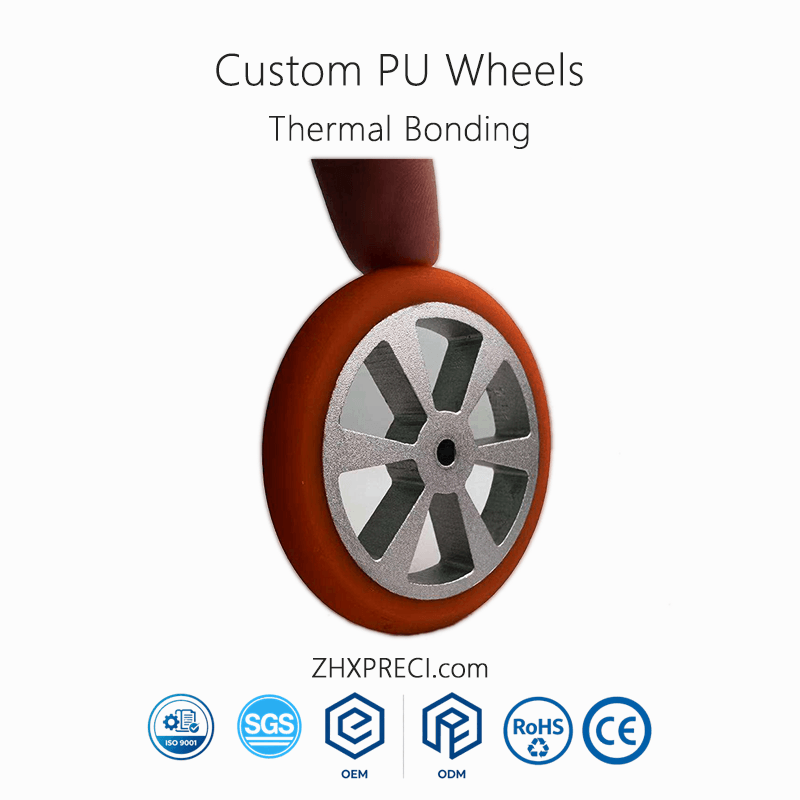
Custom Vibration Damping Polyurethane Wheels for Microscopes
Our custom vibration damping polyurethane wheels for microscopes are made in our China factory around a cast polyurethane tread, a resilient core and a tuned viscoelastic damping layer that absorbs floor-borne vibration at the contact point instead of letting it travel up the instrument stand and blur the image at high magnification. For laboratory managers and microscope OEMs running long measurement sessions, that means sharper focus, fewer re-adjustments and quieter movement across tiled, epoxy or raised-access floors. As a professional supplier with more than ten years of export experience, we treat every order as a custom solution project rather than a catalog sale: outer diameter, tread width, bore size, Shore A hardness, bearing type and mounting format are matched to your stand design, and our engineers give you straightforward advice on load rating and damping level before you commit to a wholesale order. The compound is formulated for low rebound, so rolling energy turns into a small amount of internal heat instead of vibration, which is why these wheels hold image stability better than solid nylon or hard rubber casters on the same floor.
We work with microscope OEMs, laboratory furniture manufacturers and distributors who need a repeatable part rather than a generic caster. Every batch is produced from the same compound recipe and cured under controlled conditions, so the tenth shipment feels and performs like the first. If your application has an unusual floor surface, a heavy granite base or a specific noise target, tell us the working conditions and we will propose a compound and geometry combination that fits.
Why Choose Our Vibration Damping Microscope Wheels
The standout feature is the compound itself. Our cast polyurethane tread is formulated for low rebound loss, which gives it the ability to convert rolling energy and floor vibration into a small amount of internal heat rather than transmitting it into the frame. Compared with solid nylon or hard rubber casters that pass vibration almost directly into the stand, this damping behaviour keeps the optical path stable, so you spend less time re-focusing and more time collecting usable data.
The practical benefit is a quieter, steadier instrument. Microscope users working at 400x or above often notice that image drift starts with the floor and the wheels, not with the optics. A damping polyurethane wheel reduces that transmission path, which in turn cuts rework time, protects delicate slide positioning and lowers the risk of expensive re-calibration. This is not a theoretical claim: we test each compound family on a load bench, run rolling cycles to check dimensional stability, and keep the test records with the production batch for traceability. Buyers who compare total cost of ownership, not only unit price, usually find that a longer-lasting damped wheel is the cheaper choice over a full instrument service cycle.
- Damping polyurethane tread: absorbs floor vibration and rolling noise, which keeps the microscope image stable during fine adjustment.
- Custom geometry: diameters, tread widths and bore sizes are machined to your drawing, so the wheel drops into your existing stand design without adapters.
- Multiple core options: aluminum alloy, steel or engineering plastic cores are available depending on load, weight target and cost level.
- Low rolling resistance: easier to reposition a heavy microscope platform without jerking or scuffing the floor.
- Consistent batches: fixed compound recipe and documented process control for OEM, ODM and OBM programs.
- Export-ready service: professional advice on hardness selection, a clear price suggestion for your order quantity, and full documentation for customs and quality audits.
Specifications
The table below lists the typical ranges we produce for custom vibration damping polyurethane wheels for microscopes and other precision instruments. Values outside these ranges are often achievable, so if your drawing calls for a size you do not see here, send it over and we will confirm feasibility with our technical team.
| Parameter | Typical Range | Customized Options |
|---|---|---|
| Product | Custom vibration damping polyurethane wheels for microscopes | OEM and ODM versions with your part number |
| Outer diameter | 40 mm to 100 mm | Made to drawing, including odd sizes |
| Tread width | 15 mm to 40 mm | Narrow treads for compact stands |
| Bore diameter | 8 mm, 10 mm, 12 mm | Plain bore, threaded stem or bearing seat |
| Tread hardness | Shore A 70 to 95 | Softer for maximum damping, harder for load |
| Load capacity per wheel | 20 kg to 80 kg | Higher ratings with reinforced core |
| Damping layer | Viscoelastic polyurethane compound | Thickness and placement tuned per application |
| Core material | Aluminum alloy, steel, engineering plastic | Selected to balance weight and cost |
| Bearing type | Precision ball bearing, plain bore | Sealed bearing for dusty environments |
| Mounting format | Stem, plate or bolt-through | Matched to your existing stand |
| Operating temperature | -20 °C to +60 °C | Alternative compounds for wider ranges |
| Color | Natural amber, grey, black | Custom color for brand differentiation |
Material Properties
These figures describe how the compound behaves in service rather than just how it looks on a data sheet. They are typical values from our internal testing and production records, and they can shift slightly with hardness selection and core design.
| Property | Typical Value | What It Means In Use |
|---|---|---|
| Hardness | Shore A 70 to 95 | Softer compounds damp more vibration, harder compounds carry more load |
| Tensile strength | 25 MPa to 40 MPa | Resists tearing when the wheel rolls over tile joints and thresholds |
| Abrasion loss | Typically below 80 mm³ (DIN 53516 method) | Longer service life on abrasive epoxy and concrete floors |
| Rebound resilience | 30% to 55% | Lower rebound means more energy absorbed instead of transmitted to the microscope |
| Compression set | Typically 25% or less after 22 h at 70 °C | Keeps the tread round, so rolling stays smooth over time |
| Dynamic load capacity | 20 kg to 80 kg per wheel | Supports granite-base stands and multi-instrument trolleys |
| Vibration transmission | Noticeably reduced compared with solid nylon or hard rubber wheels | Less image drift at high magnification and less re-focusing |
| Floor protection | Non-marking, low scuffing | Safe for laboratory vinyl, tile and coated floors |
Choosing a hardness level is a trade-off worth discussing early in the project. Compounds near Shore A 70 damp vibration most effectively and suit lightweight optical stands and portable inspection benches, while compounds near Shore A 90 to 95 deform less under load and are the better starting point for heavy granite-based platforms or multi-instrument trolleys. If you are not sure which side of the range fits your instrument, send us the total weight, the number of wheels, the floor type and the magnification you normally work at, and we will propose a starting point together with a sample for your own bench test before you place a production order.
Product Details And Customization Scope
Every wheel is produced as a bonded unit rather than an assembled one, which prevents the tread from separating from the core under repeated side loads. The bonding interface is inspected before curing and again after finishing.
- Tread surface is machined concentric to the bore, keeping runout low so the microscope platform tracks straight.
- Damping layer position can be placed under the tread, inside the hub or between hub and core, depending on the frequency range you are targeting.
- Stem and plate mounts are supplied with the matching hardware for direct replacement on existing stands.
- Surface finish can be smooth or lightly textured for grip on smooth laboratory flooring.
- Marking can be added with your part number, hardness code or batch trace number.


About Us
We are a China-based manufacturer and supplier of custom polyurethane wheels and rollers, serving laboratory equipment builders, material handling integrators and industrial distributors for more than a decade. Our focus is small to medium volume precision parts where the compound, the tolerance and the repeatability matter more than the catalog price. Working with us means dealing directly with the production team instead of a trading layer, which usually shortens the communication loop and keeps the quotation transparent.
Customers typically come to us with a vibration problem, a floor compatibility issue or an existing wheel that wears out too fast. We look at the load, the floor, the speed and the instrument sensitivity, then recommend a compound and geometry rather than pushing a standard stock part. Our export experience covers the European, North American, Southeast Asian and Middle Eastern markets, and we are comfortable supporting wholesale programs, private label projects and full OEM, ODM and OBM development.
Customers Visiting


Factory And Equipment
Our workshop runs casting, curing, machining and assembly under one roof, which keeps lead times predictable and quality checks close to the process. Key equipment includes vacuum casting lines, temperature-controlled curing ovens, CNC lathes for tread and bore machining, dynamic balancing stations and a load test bench for rolling and compression checks.
- Incoming material inspection for polyurethane prepolymer and cores
- Batch-level hardness and density verification before molding
- Dimensional inspection of bore, diameter, width and runout after machining
- Rolling and load testing on representative samples from each batch
- Final visual and functional check before packing
Because we are a factory rather than a reseller, we can adjust tooling and compound quickly when a customer’s requirement changes, and we can hold a stable price for repeat orders once the specification is locked. Customers and inspection agencies are welcome to visit the plant, and if travelling is not practical we can arrange a live video walkthrough of the casting, machining and testing lines so you can see the process before the first shipment.


Quality Control And Certifications
Production follows a documented quality management system, and test records are retained per batch so that any wheel can be traced back to its material lot and process conditions. Depending on the destination market and order volume, we can provide material reports, dimensional inspection reports and third-party inspection support. Certificates covering our management system and product compliance are kept on file and shared with qualified buyers on request, together with the batch test data that supports them.


Production And Inventory Policy
Lead time: Actual lead time is affected by raw material supply, machine scheduling and peak-season workload, so it naturally varies. We will give you the most accurate delivery estimate we can after order confirmation and keep you updated throughout production.
Stock status: We generally do not hold finished stock, although a small number of fast-moving standard sizes may be available. Real stock quantities change continuously with sales and production, so please contact us to confirm current availability before placing an order.
Bulk and urgent orders: For large volumes or time-critical projects, talk to us early about capacity and scheduling. We will do our best to fit your timeline wherever the production plan allows.
Frequently Asked Questions
Can you produce custom vibration damping polyurethane wheels for microscopes in the exact size and hardness we need?
Yes. Most of our work is customized rather than catalog-based. Send us the outer diameter, tread width, bore size, mounting type and the load per wheel, and we will suggest a Shore A hardness and damping layer thickness. If you already have a drawing or a sample wheel, we can work from that as well and return a quotation with a clear price suggestion.
How do these wheels reduce vibration compared with standard rubber or nylon casters?
The difference comes from the compound and the damping layer. Rubber and nylon treads are relatively elastic or very hard, so floor vibration passes through them into the instrument stand. Our polyurethane compound is formulated with lower rebound resilience, and the viscoelastic layer converts part of that vibration into internal heat. In practice this lowers the amount of movement reaching the microscope body, which helps keep the image stable at high magnification.
Which hardness should I choose for high-magnification work on a granite-based stand?
High magnification is usually more sensitive to vibration than to load, so we often start around Shore A 75 to 85 for a granite platform and adjust from there. The damping layer thickness and the core stiffness matter just as much as hardness, which is why we prefer to send a trial sample rather than fix the specification from a table alone. Once you test it on your own floor at your working magnification, we can lock the compound and quote repeat quantities with confidence.
What is your minimum order quantity and typical lead time?
For existing specifications we can often start from a few hundred pieces, and for new tooling or new compound development the first order is usually a bit larger to cover setup. Lead time depends on tooling status, material availability and current machine load, so we confirm it per order rather than quoting a fixed number. Simple repeat orders generally move through production faster than first-time custom projects.
Can these wheels be retrofitted onto microscope stands we already have in the field?
In most cases yes. We match the bore diameter, stem thread or mounting plate to your existing design so the wheel is a direct replacement. If the original wheel is a non-standard size, send a photo with basic measurements and we will confirm the closest feasible configuration before you order.
How do you control quality, and what documentation can you provide?
Each batch goes through incoming material checks, in-process inspection during casting and machining, and final dimensional and functional testing. We retain batch records so a delivered wheel can be traced to its material lot. Depending on your market requirements, we can supply dimensional reports, material information and support for third-party inspection arranged by your side.
Do you support OEM and ODM development, including private labeling?
Yes. We regularly build wheels to customer part numbers, apply customer-specific packaging and marking, and develop new geometries for OEM and ODM programs. If your project needs a compound tuned to a particular floor type or vibration frequency, our technical team can work through prototypes with you before locking the specification.
What are your payment and shipping arrangements for export orders?
We accept the usual international payment methods and confirm the details in the quotation. For shipping, we can work with your forwarder or arrange transport by sea, air or express depending on volume and urgency. We are based in China and ship worldwide, so documentation for customs clearance is prepared as part of the order process.
Looking for a reliable manufacturing partner for your microscope wheel project? Tell us your load, floor type and target size, and we will come back with a practical recommendation, a sample plan and volume pricing. These wheels are for sale in small trial quantities as well as full wholesale runs, and our team stays with your project from the first drawing through to repeat production, so you are not left guessing on specifications.
Reviews
There are no reviews yet.