


Description
Custom Low Speed Polyurethane Wheels for Positioners
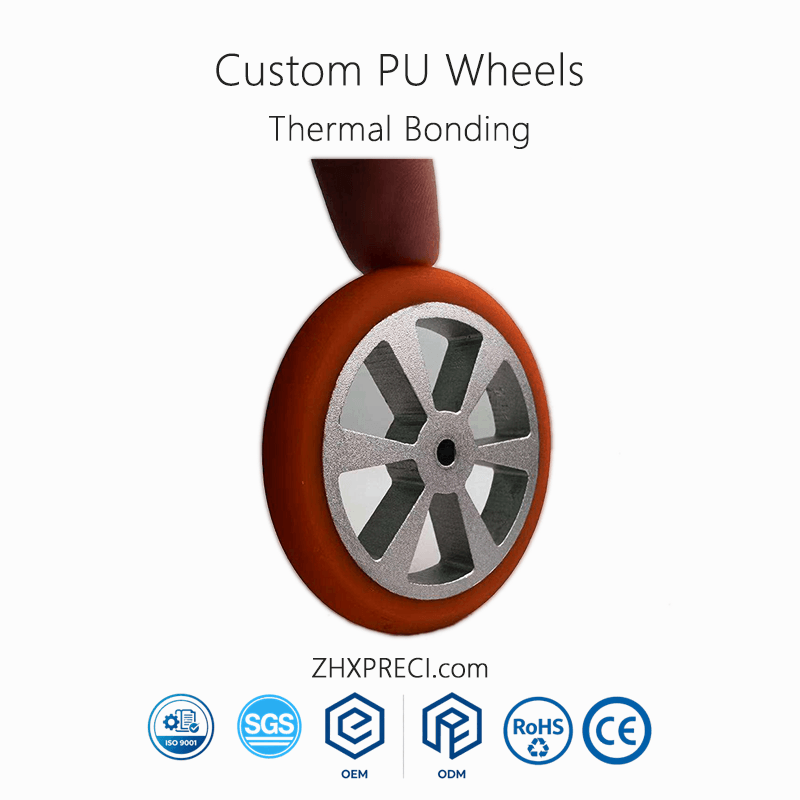
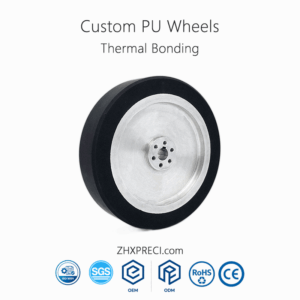
Our custom low speed polyurethane wheels for positioners are built for equipment that must hold a precise position rather than travel at speed — rotary welding positioners, assembly turntables, indexing tables and heavy-load transfer platforms. Every wheel is cast in our own China factory with a customer-specified polyurethane hardness from Shore A 70° to 98°, bonded onto a machined steel or aluminum core, then finish-ground so the tread runs true at very low rpm. Unlike standard rubber wheels, the polyurethane tread resists flat spotting and compression set, so a positioner keeps the same index position shift after shift instead of drifting as the wheel slowly deforms. That dimensional stability is what keeps your indexing accuracy inside the tolerance you designed for, and it translates into fewer rejected parts, less re-calibration downtime and lower maintenance cost per machine over its service life. Because we manufacture in-house as a professional supplier rather than buying through traders, we can hold a competitive price on wholesale and OEM volumes while still grinding each tread to a ±0.1 mm diameter tolerance. Each batch is checked for dynamic balance, bore tolerance and hardness, and the measurable results are recorded and shipped with the order, so your incoming inspection has real numbers to compare against. Diameter, width, bore, keyway, tread profile and bearing type are all produced to your drawing, with full OEM and ODM customization support from an experienced manufacturer in China.
Why Choose This Product
Positioner builders have a specific problem: at very low rotation speeds, rubber wheels build up a stick-slip effect that shows up as tiny jumps in the workpiece, and soft treads develop flat spots that throw off repeatability. Our low speed polyurethane formulation was developed to remove that behaviour. Because the tread is harder and more dimensionally stable than rubber, it starts and stops smoothly and returns to its original shape after long static loads, which keeps your indexing accuracy within the tolerance you designed for. For a wholesale buyer or equipment integrator, this translates directly into fewer rejected parts, less re-calibration time and lower maintenance cost per machine over its service life. We back that claim with batch-level hardness, bore and dynamic balance records produced on an ISO 9001:2015 certified line, so the wheel you fit on the tenth machine behaves like the one on the first.
- Machined and ground tread for concentricity and low runout
- Hardness selected to match load, surface and required grip
- Steel, stainless steel or aluminum core to suit corrosion and weight limits
- Bore, keyway and bearing configuration made to your drawing
- Dynamic balance checked on every production batch
- ISO 9001:2015 quality management across the whole production line
- OEM and ODM customization with engineering advice before you commit to a tooling order
Specifications
The table below lists our regular production range for custom low speed polyurethane wheels for positioners. Because these wheels are made to order, any dimension inside the stated range can be adjusted for your positioner design — send us your drawing or application details and our engineers will confirm feasibility and price.
| Parameter | Typical Value / Option |
|---|---|
| Product name | Custom low speed polyurethane wheels for positioners |
| Wheel diameter | 50 mm – 500 mm, custom on request |
| Tread width | 20 mm – 150 mm, custom on request |
| Polyurethane hardness | Shore A 70° – 98°, selected to application |
| Core material | Carbon steel, stainless steel or aluminum alloy |
| Bore diameter | 8 mm – 80 mm, machined to drawing |
| Bearing type | Ball bearing, roller bearing, plain bore or customer-specified |
| Load capacity | 50 kg – 2,000 kg per wheel, depending on size and hardness |
| Working speed | Low speed, typically up to 30 rpm for positioner duty |
| Bore tolerance | ±0.05 mm on machined bores |
| Diameter tolerance | ±0.1 mm on ground tread |
| Tread finish | Machined or ground, optional grooving and crown profile |
| Colour | Natural amber, black, red, green or custom pigment |
| Production process | PU casting and bonding, CNC machining, finish grinding |
| Certification | ISO 9001:2015 quality management system |
| Minimum order quantity | 10 pcs for standard sizes, 50 pcs for fully custom tooling |
| Lead time | 7 – 25 working days depending on quantity and customization |
| Packing | Carton with pallet, or export-standard wooden case on request |
| Payment terms | T/T, L/C at sight, Western Union; PayPal accepted for samples |
| Shipping | Express, air freight or sea freight, arranged to your schedule |
| Place of origin | China |
Details Images


Material Properties
The figures below describe our standard casting-grade polyurethane. They are indicative values from routine factory testing and can be adjusted with formulation changes — for example, a polyester-based system improves oil resistance, while a higher cross-link density raises load capacity at the cost of slightly lower resilience.
| Property | Typical Value | Notes |
|---|---|---|
| Hardness | Shore A 70° – 98° | Selected to balance load capacity and surface grip |
| Tensile strength | 35 – 55 MPa | Higher in harder formulations |
| Tear strength | 60 – 100 kN/m | Resists edge chipping under side loads |
| Abrasion loss | ≤ 30 mm³ (DIN 53516) | Lower loss means longer tread life |
| Compression set | ≤ 25% at 70°C for 22 h | Controls flat spotting under static load |
| Rebound resilience | 45% – 65% | Affects rolling smoothness at low speed |
| Operating temperature | −20°C to +80°C | Short peaks up to +100°C |
| Oil and grease resistance | Good; excellent with polyester-based PU | Confirm if the wheel contacts lubricants |
| Friction on steel | 0.5 – 0.8 | Varies with hardness, load and surface condition |
| Noise under load | Lower than rubber | Useful in enclosed production cells |
For positioner applications we normally recommend Shore A 85° – 95°: hard enough to avoid flat spotting and stick-slip at low rpm, soft enough to grip the track or floor without marking it. If your positioner carries a heavy static load for long periods, ask our engineers about a higher resilience grade.
Choosing Hardness, Core and Bearing for Your Application
Wheel performance on a positioner is decided by three choices made before production: hardness, core material and bearing arrangement. A harder tread at the top of the range reduces rolling resistance and holds shape under long static loads, which suits indexing tables that must repeat the same stop position thousands of times. A softer tread at the lower end of the range gives more grip on painted floors and reduces marking, which suits turntables handling finished surfaces. Core choice follows the environment: carbon steel for normal indoor duty, stainless steel where wash-down or humidity is present, and aluminum where the total machine weight must stay low. Bearing selection then follows the load and the mounting method — a plain bore is simplest where the wheel turns on a fixed shaft, while a ball or roller bearing suits higher radial loads or faster indexing. Send us these three details with your drawing and our engineers will confirm a combination that matches your duty cycle rather than over-specifying it.
Customization and Engineering Support
Because every positioner is built differently, we treat these wheels as a custom component rather than a catalogue item. Send us the wheel diameter, tread width, bore size, keyway dimensions, expected load per wheel and the surface the wheel runs on, and our technical team will come back with a recommended hardness, core material and bearing arrangement before any tooling is cut. We also produce matching wheel sets so that all units in one machine share the same hardness and diameter tolerance.
- Drawing-based production, including non-standard bores and keyways
- Hardness matched to your load and surface conditions
- Steel, stainless steel or aluminium cores for weight and corrosion control
- Tread grooving, crowning or flat profile as required
- Colour matching and laser marking for OEM brands
- Prototype and sample runs before volume production
About Us


We are a China-based manufacturer of polyurethane and rubber wheels, rollers and custom polyurethane components, serving equipment builders, distributors and industrial buyers worldwide. Our focus is on custom parts rather than mass-market stock items, so we are used to working from drawings, samples and application descriptions. Over the years we have supplied wheels for positioning equipment, transfer carts, conveyor systems and automated handling lines, and that experience is available to you as practical advice on hardness, core design and tolerance.
Buyers who work with us usually come for three reasons: they want a manufacturer rather than a trading middleman, they need customization that catalogue suppliers cannot offer, and they want consistent quality across repeat orders. We keep production, quality control and export documentation under one roof, which keeps lead times predictable and communication direct.
Factory and Equipment
Our production line covers the full process from core preparation to finished wheel. Cores are turned on CNC lathes, prepared by blasting and bonding primer, then cast or compression-moulded with the polyurethane compound. After curing, wheels are machined and ground to final dimension, checked for hardness and dynamic balance, and packed for export. Because machining and testing happen in the same facility, we can hold tight tolerances on bore and diameter on repeat orders rather than only on the first batch.


- CNC turning and grinding equipment for cores and finished treads
- Controlled polyurethane casting and curing area
- Hardness, dimensional and dynamic balance testing stations
- Dedicated inspection bench for outgoing orders
- Export packing area with carton, pallet and wooden case capability
- Production capacity that supports both sample runs and regular volume orders
Quality and Certifications
Our quality management system is certified to ISO 9001:2015, and that system governs incoming material checks, in-process inspection and final outgoing inspection. For custom wheels, we record the hardness, bore diameter, outside diameter and balance result for each batch, and these records can be supplied with the shipment so that your incoming inspection has something to compare against. If your project requires third-party inspection before shipment, we can arrange the timing so an inspector is on site when the order is finished.


Production and Inventory Policy
Lead time: Actual lead time is affected by raw material supply, machining capacity and peak season workload, so it can vary reasonably. Once your order is confirmed we will give you the most accurate delivery estimate we can and keep you updated throughout production.
Stock status: We generally do not hold stock, though a limited number of fast-moving regular sizes may be available. Actual stock quantity changes with sales and production, so we recommend contacting us to confirm live availability before placing an order.
Bulk and urgent orders: For large volume or time-critical orders, please talk to us early about capacity and scheduling. We will do our best to match your timetable.
Frequently Asked Questions
Can you custom-make wheels to match our positioner drawing?
Yes. Diameter, tread width, bore, keyway, tread profile and bearing type are all produced to your drawing, and we can also work from a physical sample if you do not have a drawing. Send the dimensions together with the load per wheel and the running surface, and we will confirm hardness and core material before production.
What polyurethane hardness is right for a low speed positioner?
For most positioner duty we suggest Shore A 85° to 95°. This range is hard enough to avoid flat spotting and stick-slip at very low rpm, and soft enough to grip the track without marking it. If your positioner holds a heavy static load for long periods, a higher resilience grade may suit better, and our engineers can advise based on your load and cycle.
How does your wheel differ from a standard rubber wheel?
Rubber treads deform under static load and tend to develop flat spots, which shows up as small position errors on a positioner. Polyurethane has higher tensile and tear strength, better abrasion resistance and much lower compression set, so the wheel holds its shape, runs true at low speed and lasts longer between replacements. It also produces less noise under load.
What load capacity can one wheel carry?
Depending on diameter, tread width and hardness, a single wheel in our custom low speed polyurethane wheels for positioners range carries roughly 50 kg to 2,000 kg. Load capacity is not fixed by size alone — the core design, bearing selection and expected duty cycle all matter. Share your load per wheel and we will recommend a suitable combination rather than over-specifying.
What is the minimum order quantity?
For standard sizes the minimum is typically 10 pieces. Fully custom items that require new tooling usually start at 50 pieces. Sample orders below these quantities can sometimes be arranged, so it is worth asking if you need a prototype for testing.
How do you control quality on repeat orders?
We work to an ISO 9001:2015 certified quality management system with incoming material checks, in-process inspection and final outgoing inspection. For custom wheels we record hardness, bore diameter, outside diameter and dynamic balance results for each batch, and these records can be sent with the shipment. Third-party inspection before shipment can also be arranged.
What payment and shipping methods do you accept?
We accept T/T, L/C at sight and Western Union, with PayPal available for sample orders. Shipping is arranged by express courier, air freight or sea freight depending on quantity and your schedule. For wholesale orders we will quote the most economical option that still meets your delivery date.
Looking for a reliable manufacturing partner for your positioner wheels?
Get in touch for quick quotes, custom samples and volume pricing. Our engineers are happy to review your drawing and suggest the right hardness, core and bearing combination — from design through to delivery.
Reviews
There are no reviews yet.