


Description
Custom Rigid Polyurethane Wheels for Rail Tracks
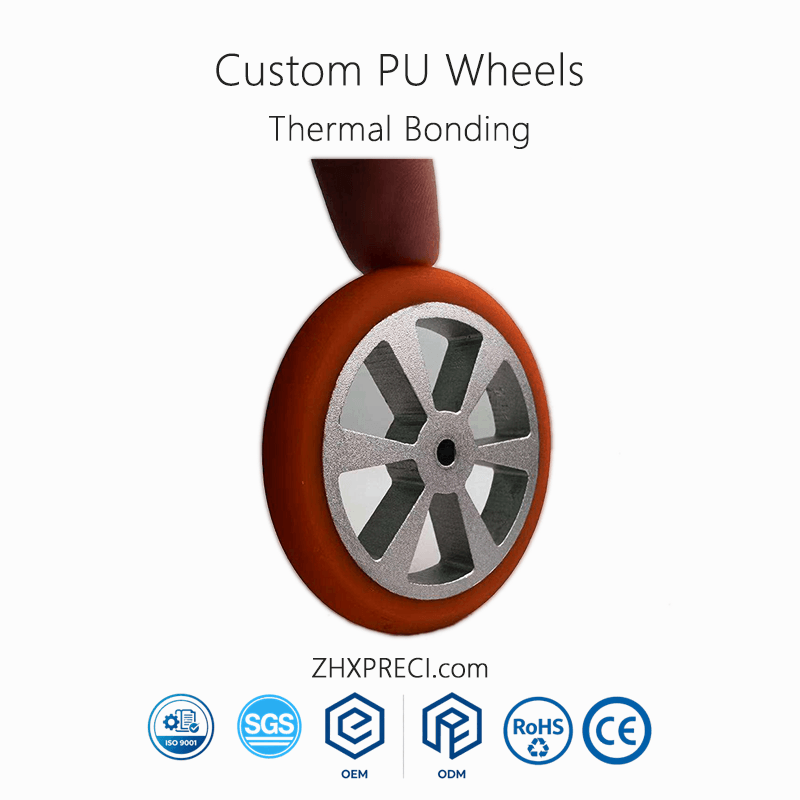
Our custom rigid polyurethane wheels for rail tracks are engineered and produced in our own factory in China for rail-guided transfer carts, track-mounted handling platforms and heavy-duty industrial rail equipment. The rigid polyurethane tread is cast directly onto a machined steel or cast-iron core, then finished by turning and grinding, so the wheel keeps its shape under continuous load instead of flat-spotting the way softer rubber treads often do on long rail runs. Tight concentricity and controlled face runout mean less vibration, quieter travel and more accurate positioning of the carriage along the track. We work as a professional OEM and ODM partner: send us your drawing, load requirement, rail profile and duty cycle, and our engineers will give you practical advice on hardness, core design and a realistic price suggestion for your market before the tooling is fixed. Units are for sale in trial quantities as well as full wholesale production runs, so you can validate performance on site before scaling up. Every batch is dimensionally inspected and delivered with an inspection record, which is how we keep quality consistent for buyers who run these wheels around the clock.
Why Choose Our Custom Rigid Polyurethane Wheels for Rail Tracks
Rail-guided equipment rarely fails because of the frame, it fails at the wheel. We built this product line around that reality, combining a rigid, high-hardness polyurethane tread with a solid machined core, so the wheel carries heavy loads without deforming and keeps rolling smoothly through thousands of cycles. Compared with standard rubber or nylon alternatives, the rigid polyurethane tread offers better abrasion resistance at the same load, lower rolling resistance and far more stable geometry over time, which means fewer replacement stops and less unplanned downtime on your line.
- Rigid polyurethane tread cast and bonded to a machined core, so the tread does not separate or peel under shear load the way glued-on tyre solutions often do.
- Machined running surface, turned and ground after casting to hold concentricity and face runout within tight limits, reducing track noise and vibration during low-speed travel.
- Tailored hardness and core design, with Shore D ranges for rigid rail duty or softer variants where shock absorption matters more than stiffness.
- Full customization, with bore, keyway, hub length, flange, bearing seat and colour matched to your drawing, including OEM and ODM projects supplied under your own marking.
- Verifiable quality, supported by material batch records, dimensional inspection reports and a documented quality control flow for every production lot.
Specifications
The table below shows the typical range we produce most often for rail track applications. Because these are custom rigid polyurethane wheels for rail tracks, final dimensions, hardness and load rating are confirmed after our engineering team reviews your drawing, load case and rail profile. Wholesale and OEM quantities are quoted separately with volume pricing.
| Parameter | Typical Range | Customization |
|---|---|---|
| Wheel outer diameter | 100 mm – 600 mm | Made to your drawing |
| Tread width | 40 mm – 150 mm | Custom width and profile |
| Polyurethane hardness | Shore D 60 – 75 for rigid rail duty | Softer Shore A grades on request |
| Core material | Carbon steel, alloy steel or cast iron | Stainless or special alloys available |
| Load capacity per wheel | Confirmed by size, core and duty cycle | Engineering review before quotation |
| Bore and hub type | Plain bore, keyed bore, taper lock, bearing seat | Machined to your shaft tolerance |
| Running accuracy | Controlled concentricity and face runout | Tighter limits on request |
| Operating temperature | −20 °C to +80 °C typical | High-temperature grades available |
| Surface finish | Machined or ground running surface | Specified roughness per application |
| Colour | Natural amber | Custom pigment on request |
Material Properties
Rigid polyurethane is chosen for rail track wheels because it holds its shape under load far better than conventional elastomers while still absorbing the small shocks that travel along a rail joint. The values below describe the typical behaviour of the cast system we use; hardness and formulation are adjusted to your load and speed so that wear life and rolling resistance stay balanced.
| Property | Typical Behaviour | What It Means for Your Equipment |
|---|---|---|
| Hardness | Shore D 60 – 75 (rigid grades) | Minimal deformation under heavy vertical load, so the carriage stays level along the track. |
| Abrasion resistance | High, in the range typical of premium cast PU systems | Longer service interval between wheel changes, especially on continuous running lines. |
| Compression set | Low under rated load | The wheel returns to its original shape after unloading and does not develop flat spots during parking. |
| Tear strength | Good, with strong tread-to-core bond | Resists edge chipping and tread separation on rough or misaligned track sections. |
| Oil and chemical resistance | Good against common workshop oils, greases and coolants | Suitable for industrial halls where lubricant and coolant spillage is normal. |
| Moisture and hydrolysis resistance | Stable in humid and mildly wet environments | Reliable in unheated warehouses, wash-down areas and coastal climates. |
| Temperature range | −20 °C to +80 °C typical | Covers most indoor and sheltered outdoor rail installations; special grades for extremes. |
| Bond strength to core | Cast-in bond rather than adhesive | Prevents tread slipping or peeling at high torque and during frequent direction changes. |
Product Details and Application Fit
Rigid PU tread on a machined core
The tread is cast around a prepared steel or cast-iron core and then machined to final size. This gives a wheel whose outer surface is dimensionally accurate against the bore, which is what keeps a rail-guided carriage tracking straight rather than crabbing along the rail.
Rail-guided transfer carts
Used as the running or guide wheels on rail-mounted transfer carts in steel plants, assembly halls and heavy machinery workshops. The rigid tread carries the load, while the controlled runout keeps travel smooth at low speed and under frequent start-stop cycles.
Track-mounted handling platforms
Applied on shuttle platforms, rail-guided lifting frames and inspection trolleys. Custom bore, keyway and flange options let the wheel bolt straight onto your existing axle without redesigning the carriage.
Specialty rail equipment
Also produced for stage machinery, rail-guided doors, automated storage rails and other installations where a quiet, low-vibration and wear-resistant wheel is required. Tell us the track profile and we will suggest a matching tread radius and flange geometry.


About Us
We are a China-based manufacturer and supplier of cast polyurethane wheels, rollers and custom industrial components, serving buyers across Europe, North America, the Middle East and Southeast Asia. Our workshop is equipped for casting, core preparation, CNC turning, grinding and dimensional inspection, which means the whole process from raw material to finished wheel happens under one roof. That structure lets us act as a genuine OEM, ODM and OBM partner: we can produce to your drawing, develop a new profile with our engineers, or supply under your own brand. Over the years we have supplied custom rigid polyurethane wheels for rail tracks to cart builders, maintenance contractors and equipment distributors, and the same engineering team handles every enquiry, from the first technical question to the final shipping document. If you are comparing suppliers, we are happy to give you honest advice on what is realistic for your load case rather than promise everything.

Production and Inventory Policy
Lead time: Actual lead time varies with raw material supply, machining capacity and peak season workload, so reasonable fluctuations should be expected. Once your order is confirmed, we provide the most accurate delivery estimate we can and keep you updated throughout production.
Stock status: We generally do not hold stock, though a small number of fast-moving standard wheels may be available. Real stock quantities change constantly with sales and production, so please contact us to confirm live availability before placing an order.
Bulk and urgent orders: For large volumes or urgent requirements, please talk to us early about capacity and scheduling. We will do our best to fit your timeline and keep you informed at every stage.
Factory and Equipment
Our production area is organised around the three steps that decide wheel quality: core preparation, polyurethane casting and precision machining. Cores are cleaned and prepared before casting so the bond between metal and polyurethane is reliable. Casting is carried out with controlled material ratios and curing schedules, and finished wheels are turned and ground on CNC equipment to hold the bore, outer diameter and face runout specified on your drawing. Inspection follows every batch, with dimensional checks recorded before packing. Because we control these steps in-house, we can adjust hardness, tread profile and core geometry quickly for customized orders instead of waiting on an outside supplier.


Certifications and Quality Control
Quality control starts with incoming raw material and continues through casting, machining and final inspection. Material batches are recorded so that a delivered wheel can be traced back to its production lot. Dimensional inspection reports, hardness checks and visual inspection results are available with shipment on request, and our factory operates under an ISO 9001 based quality management system. Certificates and test documentation can be provided for buyers who need them for their own quality files or for end-customer approval.


Customer Visits
Buyers from Europe, North America and Asia visit our factory each year to review production, check samples and discuss new projects. Visitors typically walk through the casting area, watch the machining of custom rigid polyurethane wheels for rail tracks on the CNC line and inspect finished batches before shipment. If you would like to arrange a visit, or prefer a live video walkthrough of the workshop instead of travelling, just let us know and we will schedule a time that suits your time zone.

Frequently Asked Questions
What is the minimum order quantity for custom rigid polyurethane wheels for rail tracks?
MOQ depends on wheel size and whether new tooling is required. For sizes we already produce, we can usually start with a small trial batch so you can test performance on your own rail system. For fully new profiles or new core designs, a slightly higher first-run quantity helps cover setup cost and keeps the unit price reasonable. Send us your drawing and expected annual volume, and we will confirm the exact MOQ for your case.
Can you manufacture to our drawing as an OEM or ODM partner?
Yes. We regularly produce to customer drawings and also develop new designs together with buyers who only have an application requirement. As an OEM partner we machine to your tolerances, marked and packed under your brand if needed. As an ODM partner we can propose tread profile, hardness and core geometry based on your load, speed and track condition, then supply sample wheels for approval before volume production.
How do you decide the right polyurethane hardness for a rail track wheel?
Hardness is matched to load and running conditions. Higher load and low speed generally call for a harder rigid grade, which keeps deformation small and protects the rail contact geometry. Where the track has joints, uneven sections or shock loads, we may suggest a slightly softer formulation to absorb impact at the cost of some rolling resistance. In most rail applications we start with a rigid Shore D grade and adjust from there after reviewing your duty cycle.
What is the typical lead time and how is shipping arranged?
Standard production usually takes a few weeks after drawing confirmation and deposit, and customized orders with new tooling take longer. Actual lead time can move with material supply, machine scheduling and peak season, so we always confirm a realistic estimate before you commit and keep you informed during production. We ship by air, sea or express according to your schedule and can work with your forwarder or arrange transport on your behalf.
How are the wheels packed for export?
Wheels are cleaned, protected against moisture and packed in strong cartons or wooden cases suitable for long-distance transport. Heavier rail track wheels are secured in wooden pallets or crates with inner bracing to prevent movement in transit. If you have specific marking, labelling or pallet dimension requirements, we can follow them as part of your customized packing instruction.
What payment methods do you accept, and can you provide samples?
We normally work with bank transfer and can discuss other terms for repeat wholesale orders. Samples are available for evaluation; for standard sizes we can supply a small quantity quickly, while custom wheels require drawing confirmation first. Tooling cost for new profiles is quoted separately, and we are glad to discuss how sample cost can be handled when a volume order follows.
Can you give price advice for wholesale volumes and market positioning?
Yes. Tell us your target quantity, destination market and expected selling format, and we will give you a clear price structure with volume breaks so you can plan your margin. As a factory supplier working directly with buyers, we can often offer a more competitive price than trading companies because casting, machining and inspection all happen in our own workshop. We are also happy to suggest which sizes and hardness grades sell best in your region.
Talk to Our Wheel Engineers
Looking for a reliable manufacturing partner for your rail track wheel project? Send us your drawing, load requirement or simply a description of your application, and our team will come back with practical suggestions, sample options and volume pricing. We are glad to support you from the first technical question through to delivery.
Reviews
There are no reviews yet.