


Description
Custom Wear Resistant Polyurethane Wheels for Ceramic Kilns
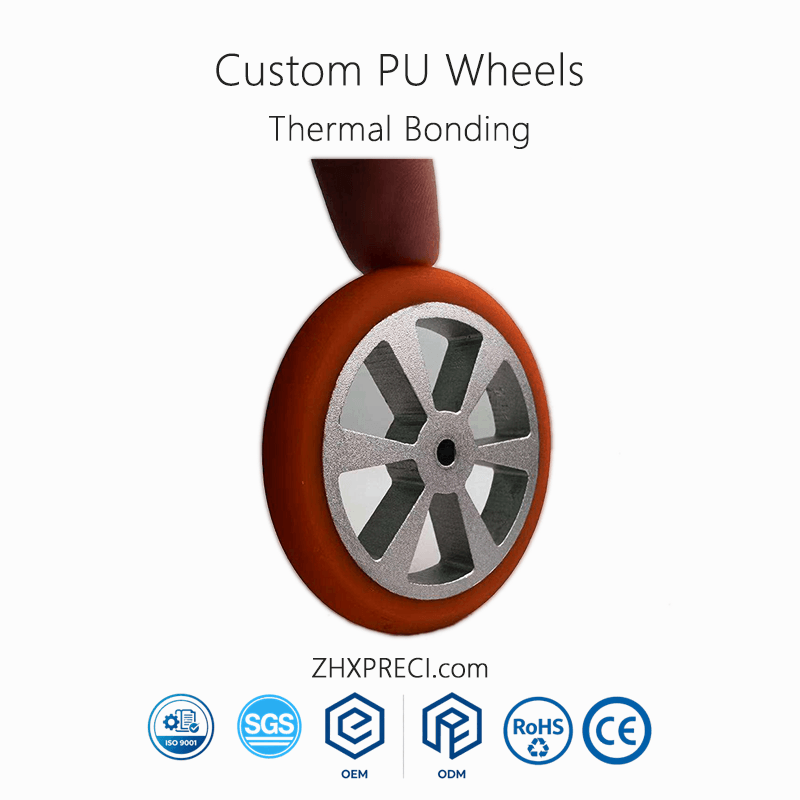
Our custom wear resistant polyurethane wheels for ceramic kilns are produced as drawing-matched assemblies rather than catalogue parts. Each wheel pairs a cast iron, carbon steel, stainless steel, or aluminium hub with a hot-cast polyurethane tread that we compound for the heat, abrasive dust, and continuous rolling load found on kiln cars, tunnel kiln transfer lines, and shuttle kiln platforms. Because the tread is cast and machined in our own factory in China, we can adjust hardness, tread profile, and bore tolerance to your equipment and quote wholesale pricing for single replacement units or long production runs. Every batch can be supplied with hardness and dimensional test reports, giving your incoming quality team a clear record to check against. Compared with standard rubber or nylon wheels, a correctly specified PU tread resists flattening and grit abrasion far longer, which helps kiln cars track straight, protects floor surfaces, and reduces the unplanned stoppages that interrupt a firing cycle.
Why Choose These Ceramic Kiln Polyurethane Wheels
- Application-matched polyurethane formulation. We select polyester or polyether based systems according to your kiln environment, so the tread keeps its shape under sustained load and resists the fine ceramic dust that wears out softer materials quickly.
- Hardness range from Shore A 70 to 95. Softer grades absorb shock and protect tile and concrete floors, while harder grades carry heavier loads with less deformation. Our engineers give expert advice on the right grade for your kiln car weight, running surface, and duty cycle before any tooling is committed.
- Hub and bearing options built to your shaft. Cast iron, steel, stainless steel, and aluminium cores are machined to H7 bores with sealed ball bearings, tapered roller bearings, or plain bores, so the wheel fits existing axle assemblies without modification.
- Tight dimensional control. Outer diameter is held to ±0.2 mm and radial runout to ≤0.1 mm on machined treads, which keeps multi-wheel kiln cars level and reduces vibration on rails and transfer tracks.
- Full customization and OEM/ODM/OBM support. Send a drawing, a worn sample, or a shaft measurement and we return a dimensioned proposal with material recommendation and a price suggestion for your order volume. Private labeling and custom packaging are available for distributors and equipment builders, and our team acts as a professional custom solution partner from first sample to repeat series.
- Traceable production. Every batch is logged by compound lot, hardness test, and dimensional inspection, and batch test reports can be supplied with shipment so your incoming quality team has documentation to check against.
Technical Specifications for Custom Wear Resistant Polyurethane Wheels
The table below summarises our standard build range for custom polyurethane kiln wheels. Values outside these ranges are often achievable through a customized solution, and we will confirm feasibility with you before quoting.
| Parameter | Typical Range or Option |
|---|---|
| Outer diameter | 80 mm to 500 mm, produced to drawing |
| Tread width | 30 mm to 120 mm |
| Tread material | Hot-cast polyurethane, polyester or polyether based |
| Hardness | Shore A 70 to 95, Shore D grades on request |
| Wheel core | Cast iron, carbon steel, stainless steel, aluminium |
| Bearing type | Sealed ball bearing, tapered roller bearing, plain bore, or customer-specified |
| Load per wheel | Up to 2,500 kg, depending on hub and bearing selection |
| Service temperature | −20 °C to +80 °C continuous, higher short peaks confirmed per application |
| Tolerances | Bore H7, outer diameter ±0.2 mm, radial runout ≤0.1 mm |
| Tread finish | Machined smooth, ground, or grooved to drawing |
| Customization | OEM and ODM to drawing or sample, private labeling, custom packing |
Material Properties and Typical Performance
Hardness drives most of the performance you will notice in service. For kiln cars rolling on dusty concrete or steel rails, Shore A 85 to 95 is a common starting point because a firmer tread carries load with less deformation and holds its profile across long firing cycles. Where shock loads, floor protection, or quiet running matter more, a slightly softer grade is usually the better trade-off. We recommend testing the proposed grade on a sample wheel under your real load before volume production, and we will tell you honestly when a requirement falls outside what polyurethane can reliably deliver. The figures below are typical ranges from our own laboratory and third-party test houses; exact values are fixed on the approved drawing and can be documented with batch test reports.
| Property | Typical Value | What It Means in Service |
|---|---|---|
| Abrasion resistance | 30 to 60 mm³ loss, DIN 53516 | Lower loss means slower tread wear in ceramic dust |
| Hardness | Shore A 70 to 95 | Sets the balance between load capacity and shock absorption |
| Tensile strength | 25 to 45 MPa | Resists tearing at the tread edge under side loads |
| Tear strength | 60 to 100 kN/m | Helps the tread survive cuts and rail joints |
| Rebound resilience | 35 to 55 % | Controls rolling noise and energy loss on long runs |
| Compression set | Low under continuous load | Limits flat spotting when a loaded car stands still |
| Temperature range | −20 °C to +80 °C continuous | Suits most kiln transfer areas away from the firing chamber |
Typical Application Scenarios
- Kiln car and transfer car wheels: matched sets for tunnel kiln and shuttle kiln cars, supplied with consistent diameter so the car stays level on the rails.
- Roller and conveyor lines in ceramic plants: low-noise PU wheels for glazing lines, sorting tables, and green tile handling where floor marking must be avoided.
- Heavy-duty material handling platforms: large-diameter wheels with cast iron cores for loads that exceed the range of standard catalogue castors.
- Replacement and retrofit projects: wheels machined to the dimensions of an existing supplier, so older kiln cars keep running without mechanical changes.
Detail Images and Inspection Points
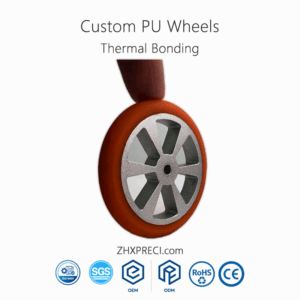
Sample photographs, tread profile sketches, and measurement reports are sent with each quotation so you can review the details before placing an order. The points we document on every custom wheel are the tread surface finish and groove pattern, the hub bore and keyway dimensions, the bearing seat tolerance, the sidewall bonding line between PU and core, and the measured hardness at three points across the tread. If you need to verify an existing wheel, we can also work from a worn sample and return a dimensioned drawing for your approval.


About Us
We are a professional manufacturer and supplier of custom polyurethane, rubber, and solid wheel assemblies based in China, serving ceramic machinery builders, kiln contractors, and material handling distributors in more than thirty markets. Our team has spent over a decade converting worn parts and rough sketches into production-ready drawings, and we are equally comfortable quoting a single replacement wheel or an OEM series for a new kiln car design. Because we cast, machine, and assemble in one plant, we control the critical variables ourselves and can tell you what is realistic for your timeline instead of promising everything. As a top OEM/ODM partner for the global market, we support customization from first concept through repeat delivery.

Factory and Equipment
Production runs on hot-cast PU mixing and dispensing units, CNC lathes for hub machining and tread turning, boring and keyway equipment, and a curing area with controlled temperature. Final inspection uses hardness testers, micrometers, bore gauges, and runout measurement on a dedicated checking fixture. Our workflow is arranged so that a customized order stays on one production route from casting through packing, which keeps traceability intact.


Quality Control and Certifications
Our quality management follows ISO 9001 practice, and copies of our management certificates plus material and dimensional test reports are available on request. Each order passes incoming material checks, in-process hardness and dimension checks, and a final inspection before packing. Where you need third-party verification, we support pre-shipment inspection arranged by your own agency or by an independent inspection company, and we will share the inspection checklist in advance so the criteria are clear to both sides.


Customer Visit Photos and On-Site Audits
Customers regularly visit our plant to review tooling, watch a trial cast, and check finished wheels against their drawings. We welcome factory visits and can arrange a video walkthrough of the production line for buyers who cannot travel. If you are evaluating several suppliers, we are happy to answer technical questions directly with your engineering team and provide reference documentation that helps you compare offers on equal terms.

Production and Inventory Policy
Lead time: Actual production time depends on raw material supply, machining capacity, and peak-season workload, so reasonable variation is normal. We provide the most accurate delivery estimate we can once the order and drawing are confirmed, and we keep you informed of any change as soon as it becomes visible.
Stock status: We do not hold stock as a rule, though a limited number of fast-moving standard sizes are kept on hand. Real stock levels change daily with sales and production, so please contact us before ordering to confirm what is available at that moment.
Bulk and urgent orders: For large-volume or time-critical projects, please talk to us early about capacity and scheduling. We will look at what can be reserved for your dates and tell you plainly what is achievable.
Frequently Asked Questions
Can you produce these polyurethane wheels to our own drawing for a specific kiln car?
Yes. Send the drawing, or a worn sample with shaft and housing measurements, and we will confirm bore, keyway, tread width, and hardness before quoting. Most customized requests for custom wear resistant polyurethane wheels for ceramic kilns are handled as a made-to-order item with a dimensioned approval drawing issued before production.
Which hardness and tread profile suit continuous ceramic kiln duty?
For loaded kiln cars on rails, Shore A 85 to 95 with a machined smooth or lightly grooved tread is the usual starting point because it resists flattening and grit embedding. If your cars cross tiled floors or need quieter running, a softer grade of Shore A 75 to 85 is often better. We will give you a clear recommendation once we know the load per wheel and the running surface.
What is your minimum order quantity and typical lead time?
MOQ depends on size and tooling: small custom batches are possible for replacement programs, while volume pricing applies to repeat series orders. Lead time is confirmed per order and is affected by material supply and workshop scheduling, so we quote a realistic window rather than an optimistic one.
How are the wheels packed, and which shipping methods do you use?
Wheels are protected with foam or cardboard separators, strapped on pallets, and shipped in export cartons or plywood cases as your order requires. We work with sea freight, air freight, and door-to-door courier services, and can ship on your forwarder account or arrange transport to your nearest port.
Which payment methods do you accept?
We normally work with T/T and can discuss other terms such as L/C for larger contracts. Payment terms are agreed in writing at the quotation stage so there is no ambiguity later.
Do you offer OEM and ODM service with our own branding?
Yes. We support OEM and ODM projects, including your logo on the hub face, custom carton printing, and neutral packing for distributors. We can also help refine a design for manufacturability if the part is still at the concept stage.
How is quality controlled before shipment?
Every order is checked for hardness, outer diameter, bore tolerance, and runout before packing, and batch test reports can be included with the documents. Pre-shipment inspection by your own team or a third-party agency is welcome, and we will share our inspection criteria in advance.
Can we order a sample wheel before committing to volume production?
Yes, sample wheels are available for evaluation and are the most reliable way to confirm hardness and fit under your real load. Please share the application details so the sample matches the specification you intend to buy.
Talk to Us About Your Kiln Wheel Project
Looking for a reliable manufacturing partner for customized polyurethane wheels? Send your drawing, load requirement, and running surface details, and we will come back with technical advice, a realistic lead time, and a wholesale price for the quantity you need. Our custom wear resistant polyurethane wheels for ceramic kilns are for sale with OEM/ODM support, and from first sample to repeat delivery, our team stays with your project and answers questions in plain terms.
Reviews
There are no reviews yet.