


Description
Custom Solvent-Resistant Polyurethane Wheels for Ink Tanks
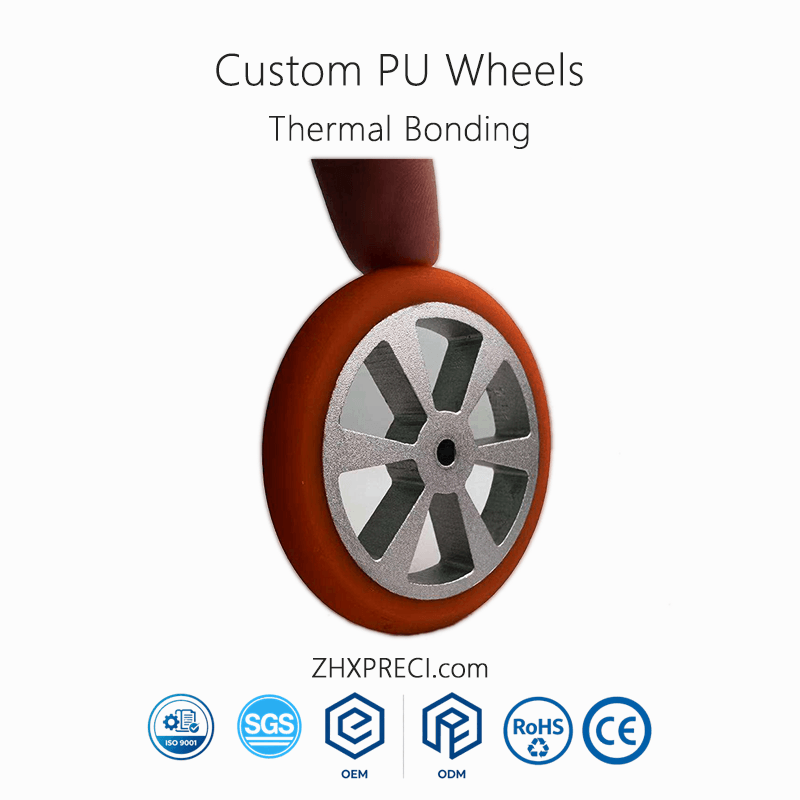
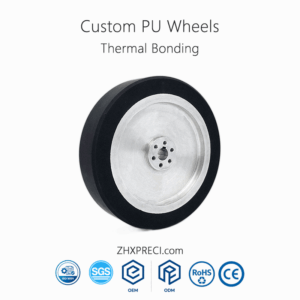
Our custom solvent-resistant polyurethane wheels for ink tanks are cast in our own factory in China, where every batch is made from a polyurethane formulation developed for continuous contact with inks, thinners and cleaning solvents. The tread is firmly bonded to a machined steel or aluminium hub, so the wheel keeps its roundness and load capacity after long exposure to aggressive chemicals. Compared with standard rubber casters or general-purpose PU wheels, this formulation swells less, hardens more slowly and releases ink residue more easily, which keeps your printing line running steadily and lowers replacement and downtime costs. Typical uses include ink tank trolleys, ink circulation carts, press-room transfer equipment and solvent handling stations in printing, labelling and packaging plants. Because this is a professional custom solution rather than a catalogue stock item, we match hardness, diameter, bore size and hub material to your drawing, and our engineering team gives expert advice on the right specification for your market and application, with a wholesale price suggestion based on your order volume. Every shipment leaves our ISO 9001 certified workshop with dimensional inspection records, hardness test results and material traceability data.
Why Choose This Product
The core of these wheels is a high-density polyurethane tread with a closed, chemically resistant surface that limits the penetration of solvents into the polymer. That structure gives a clear advantage over open-cell rubber wheels, which tend to soften, swell and leave black marks on the floor once ink or thinner soaks in. For your operation, the benefit is predictable rolling behaviour on ink tank trolleys and transfer carts, fewer wheel changes, and cleaner floors in the press room. Our workshop supports this claim with batch hardness checks, a 24-hour immersion trial in a solvent sample supplied by the customer before mass production, and full batch traceability from raw material lot to finished wheel.
- Solvent-resistant polyurethane tread cast in our China factory, with hardness options from Shore A 70 to Shore A 95 to suit load and floor conditions.
- Steel or aluminium hub with machined bore, keyway or threaded options, allowing OEM and ODM customization to your existing axle design.
- Firm chemical bonding between tread and hub reduces the risk of separation under heavy static loads on full ink tanks.
- Non-marking tread helps keep press-room floors clean and supports plant housekeeping standards.
- Low rolling resistance on smooth concrete and epoxy floors, which makes manual pushing easier for operators.
- Consistent concentricity and balanced castings reduce vibration on transfer carts carrying open ink containers.
- Professional technical advice before you order, so the hardness and bearing type match the real working conditions of your line.
- Available for sale at wholesale price levels with full OEM/ODM support for distributors and equipment builders.
Technical Specifications
The table below shows our common working range as a top professional custom solution provider in China. Final values are confirmed against your drawing, your solvent type and the load per wheel, so please share your application details for accurate expert advice and a reliable price suggestion.
| Parameter | Typical Range |
|---|---|
| Product type | Custom solvent-resistant polyurethane wheel for ink tanks and ink transfer carts |
| Wheel diameter | 50 mm to 300 mm, made to order |
| Tread width | 20 mm to 80 mm |
| Tread material | Solvent-resistant polyurethane, cast grade |
| Tread hardness | Shore A 70 to Shore A 95, selectable by application |
| Hub material | Carbon steel, stainless steel or aluminium alloy |
| Bore and fixing | Plain bore, keyway, threaded stud, bolt hole or bearing bore |
| Bearing options | Plain bearing, precision ball bearing or stainless bearing for wet areas |
| Load capacity per wheel | Consult us with your static and dynamic load; capacity depends on diameter, hardness and hub design |
| Colour | Natural amber, black, grey or custom colour on request |
| Customization | OEM, ODM and OBM projects supported, including logo marking and private labelling |
| Certification | ISO 9001 quality system, RoHS declaration and material data sheets on request |
| Place of origin | China factory, with export packing and global shipping |
| Minimum order quantity | Flexible for trial orders, confirmed per specification |
Product Details
Each wheel is built from four elements that we control in-house. The polyurethane tread is cast around the hub under controlled temperature and curing time, which gives an even wall thickness and a consistent rolling surface. The hub is machined after casting rather than before, so the bore stays true to the tread and the wheel runs without wobble on the axle. The tread edge is trimmed clean, and the sidewalls are inspected for voids or bubbles that could later allow solvent to creep in. Finally, every wheel is checked for diameter, width, bore size, hardness and visual surface quality before packing.
- Tread surface: smooth cast finish, non-marking, easy to wipe clean after ink spillage.
- Hub finish: painted carbon steel, polished stainless steel or clear aluminium, matched to your environment.
- Bearing seat: machined to tolerance so replacement bearings press in squarely and run quietly.
- Marking: batch code, hardness and size can be laser marked or moulded into the sidewall for traceability.
Detailed product photos, drawings and short videos of the casting and machining process are available on request so you can review the finish before placing a bulk order.


Material Properties
The values below describe our standard solvent-resistant polyurethane grade. They help you compare this material with rubber and general-purpose PU, and they give your maintenance team a realistic picture of how the wheel behaves in service. Where your solvent is unusual, we recommend sending a sample so we can run an immersion trial and report the actual result before production.
| Property | Test Basis | Typical Result |
|---|---|---|
| Hardness | Shore A, ISO 868 | 70 to 95, selected per application |
| Tensile strength | ISO 37 | Reliable for continuous rolling duty; confirmed per batch |
| Elongation at break | ISO 37 | Balanced elasticity for impact absorption on uneven floors |
| Abrasion resistance | DIN 53516 | Good wear resistance on concrete and epoxy floors |
| Solvent swelling | Immersion trial with customer solvent sample | Low swelling tendency; measured and reported before production |
| Oil and ink resistance | Workshop immersion check, 24 to 72 hours | Surface remains firm, cleaning is easier than with rubber |
| Temperature range | Application guidance | Discussed per project; extreme cold or heat is reviewed case by case |
| Tread to hub bond | Visual and manual pull check per batch | Firm chemical bond, no separation under rated load |
| Floor marking | Visual check on test floor | Non-marking on common industrial floors |
About Us
We are a China-based manufacturer and supplier of custom polyurethane wheels, rollers and technical PU parts for industrial equipment builders and distributors. Our workshop has served the printing, packaging, logistics and material handling markets for more than ten years, and our export team works daily with buyers in Europe, North America, Southeast Asia and the Middle East. We focus on small but critical components where the material choice decides whether a machine runs cleanly or stops for maintenance, which is why ink tank wheels, transfer cart rollers and solvent handling casters form a large part of our output.
Working with a factory rather than a trading layer means drawings are reviewed by the people who will actually cast the part. You get direct technical feedback, a transparent quotation and a realistic delivery estimate. Our engineers give practical advice on hardness, hub design and bearing selection, and we welcome OEM, ODM and OBM projects from a single prototype to repeat wholesale production.

Customers Visiting

Factory and Equipment
Production takes place under one roof, which shortens lead times and keeps quality checks close to the process. Our main equipment includes casting and curing stations with temperature control, CNC lathes for hub machining, drilling and tapping lines for bore and fixing options, a vulcanising press for bonding, hardness and dimensional inspection benches, and a packing area set up for export cartons and pallets.
- Casting and curing line with controlled mould temperature for consistent hardness across a batch.
- CNC machining centres for bore tolerance, keyways and threaded fixings.
- In-house bonding station for tread-to-hub adhesion.
- Inspection bench for diameter, width, concentricity and Shore hardness.
- Dedicated export packing area with carton, pallet and moisture protection options.


Certifications and Quality Control
Our quality system is built around documented inspection rather than verbal promises. We operate an ISO 9001 certified management system, can supply RoHS declarations and material data sheets for most grades, and keep batch records so a specific delivery can be traced back to the raw material lot and the operator who cast it. Third-party inspection before shipment can be arranged if your purchasing process requires it.
- ISO 9001 certified quality management system.
- RoHS declaration and material data sheets available for review.
- Incoming raw material checks before each production run.
- In-process checks on hardness, bore size and tread finish.
- Final pre-shipment inspection with a report issued against your order.
- Warranty support on confirmed manufacturing defects; the exact terms are stated on the order confirmation.


Production and Inventory Policy
Lead time: Actual lead time is influenced by raw material supply, machining capacity and peak season workload, so it can move within a reasonable range. Once your order is confirmed we will provide the most accurate delivery estimate we can and keep you informed of any change as soon as it appears.
Stock status: In principle we produce to order, although a limited number of popular regular sizes are held in stock. The real quantity of those items changes daily with sales and production, so please contact our team to confirm live availability before you place an order for stock items.
Bulk and urgent orders: For large volumes or tight schedules, please talk to us early about capacity and production scheduling. We will do our best to match your timeline and will tell you honestly if a date cannot be met.
Frequently Asked Questions
Can you customize the hardness, diameter and bore of these solvent-resistant polyurethane wheels for ink tanks?
Yes. This is a made-to-order product. We can cast the tread from Shore A 70 to Shore A 95, produce diameters from 50 mm to 300 mm, and machine the hub to your bore, keyway, threaded stud or bearing seat. Send us a drawing, a sample wheel or clear dimensions, and our engineers will confirm feasibility and propose the most suitable specification for your ink tank trolley or transfer cart.
How do your wheels compare with standard polyurethane or rubber wheels in solvent contact?
Standard rubber tends to swell and soften when ink or thinner soaks in, and general-purpose PU may harden or crack over repeated exposure. Our solvent-resistant formulation is cast with a denser, chemically resistant surface that limits penetration and cleans up more easily. Because results depend on the exact solvent, we prefer to run an immersion trial with a sample of your chemical and report the measured result before mass production, so you know what to expect rather than relying on a generic claim.
What is the minimum order quantity for a custom wheel project?
We keep the minimum order quantity flexible so that new customers can test the material and finish before committing to volume. Small trial batches are possible, and the confirmed quantity depends on diameter, hub complexity and whether a new mould is required. Tell us your annual or monthly demand and we will propose a practical starting quantity along with a wholesale price for repeat orders.
How long is production and delivery time?
For custom wheels, production normally starts after the drawing is approved and the deposit is received. A typical run takes roughly 15 to 25 working days, with mould development requiring additional time when a new tool is needed. Shipping by sea, air or express adds transit time depending on destination. Material supply and peak season workload can affect the schedule, so we confirm the date in writing and update you if anything changes.
How are the wheels packed for export?
Wheels are packed in export-grade cartons with inner protection to prevent chafing during transport, then strapped onto pallets for sea freight when the order volume justifies it. We can add moisture barrier bags, individual plastic sleeves, or customer-specified labels and carton printing for OEM projects. If you have a packaging standard from your warehouse or distributor network, share it with us and we will match it where possible.
What quality control and certification do you provide?
Our factory operates an ISO 9001 certified quality management system, and we can provide RoHS declarations and material data sheets for the grades we use. Each batch is checked for hardness, dimensions, bore tolerance and tread appearance, and a final inspection report is issued before shipment. If your process requires third-party inspection, we can arrange for it to take place at our workshop before the goods are packed.
What payment methods and shipping terms do you support?
We normally work on a T/T basis with a deposit at order confirmation and the balance before shipment, and we can accept a letter of credit for larger contracts. Common shipping terms include EXW, FOB and CIF, with sea freight for volume orders and air or express for urgent samples and small batches. Let us know your preferred terms and destination port, and we will quote accordingly.
How do I choose the right wheel for my ink tank trolley or transfer cart?
Start with the total load on the cart and divide it by the number of wheels, allowing a safety margin for uneven floors and dynamic movement. Then consider the floor surface, the solvent in contact and whether the cart is pushed manually or towed. Harder treads roll more easily under heavy static loads, while slightly softer treads absorb shocks better. Share these details with our technical team and we will give you a concrete specification suggestion, including hardness, bearing type and hub material.
Can you supply a sample wheel before a bulk order?
Yes. For standard sizes we can send an existing sample, and for new designs we can produce a prototype or small trial batch first. Sample cost and freight are normally charged and can be discussed against your future order volume. Reviewing a physical sample is the most reliable way to check tread finish, hardness and bore fit before you commit to production.
Talk to Our Technical Team
Looking for a reliable manufacturing partner for solvent-resistant polyurethane wheels? Send us your drawing, load figures and the solvent involved, and we will reply with a practical specification, a realistic lead time and a clear quotation. From sample approval to volume production, we support your project step by step and welcome OEM, ODM and private label work.
Reviews
There are no reviews yet.