


Description
Custom Low Friction Polyurethane Wheels for Conveyor Bends
Our custom low friction polyurethane wheels for conveyor bends are made for the curve sections where ordinary rollers start to drag, squeal and push products out of line. The tread is a low friction cast polyurethane grade, typically Shore A 85 to 92, chemically bonded to a machined steel, stainless steel or aluminium hub and finished with a ground running face, so the wheel keeps a stable surface instead of flat-spotting under continuous point load. Compared with standard rubber wheels, the lower coefficient of friction reduces the extra torque your curve conveyor has to deliver and slows down guide rail wear — most of our buyers report quieter running and fewer line stoppages on sortation and pallet transfer bends. Because we manufacture in China and supply direct as an OEM/ODM partner, the price stays competitive for custom volumes while every batch is checked for hardness, dimensions and abrasion loss before it leaves our factory. We customise diameter, width, bore, bearing and colour to suit your existing conveyor frame.
Why Choose These Low Friction Polyurethane Wheels for Conveyor Bends
Curve conveyors are usually where throughput quietly disappears: products slow down, rails wear out and drives work harder than the layout intended. We built these custom low friction polyurethane wheels for conveyor bends around that problem rather than around a catalogue number, and the results show up in daily operation rather than on paper.
- The low friction cast PU tread runs with a friction coefficient of roughly 0.15 to 0.25 on dry steel in our lab tests, which means less drive torque is needed through the bend and products keep a steadier speed instead of stalling mid-curve.
- The running face is ground and the outside diameter is held to about ±0.2 mm, so the wheel does not rock or flat-spot; transfer height stays consistent shift after shift and your maintenance team is not chasing vibration complaints.
- The hub is chemically bonded and mechanically locked to the polyurethane instead of simply pressed in, which keeps the tread in place under side loads on tight bends and extends service life.
- Bore, bearing, tread width and hardness are all open to custom specification, so the wheel drops into your existing conveyor frame without redesigning the curve section.
- Hardness, dimension and abrasion checks are recorded for each production lot, and test records can be supplied with the shipment for your incoming inspection file.
Technical Specifications
The figures below describe our standard low friction range and can be adjusted for custom projects. Send us your conveyor speed, load per metre and bend radius, and our engineers will give you a professional suggestion on wheel diameter, hardness and bearing type before you place an order.
| Parameter | Typical value |
|---|---|
| Product type | Custom low friction polyurethane wheel for conveyor bends |
| Tread material | Low friction cast polyurethane, polyester or polyether based |
| Hardness | Shore A 85 / 90 / 92 / 95, other values on request |
| Wheel diameter | 50 mm, 60 mm, 76 mm, 100 mm standard; 30 mm to 150 mm custom |
| Tread width | 20 mm to 50 mm |
| Hub material | Carbon steel, stainless steel 304/316, aluminium, engineering plastic |
| Bore and bearing | Plain bore, 6001 / 6002 ball bearing, stainless bearing, custom shaft bore |
| Load capacity | Up to 120 kg per wheel, depending on size and speed |
| Friction coefficient | Approx. 0.15 to 0.25 on dry steel, low friction grade |
| Operating temperature | -20°C to +70°C continuous |
| Colour | Amber, black, grey or custom matched |
| Tolerance | Outside diameter ±0.2 mm, bore H8 typical |
| Minimum order | 100 pieces per size for standard items, trial batches negotiable |
Values depend on hardness, hub type and operating conditions. For high speed or high load bends, we recommend a short technical review before confirming the drawing.
Product Details & Images
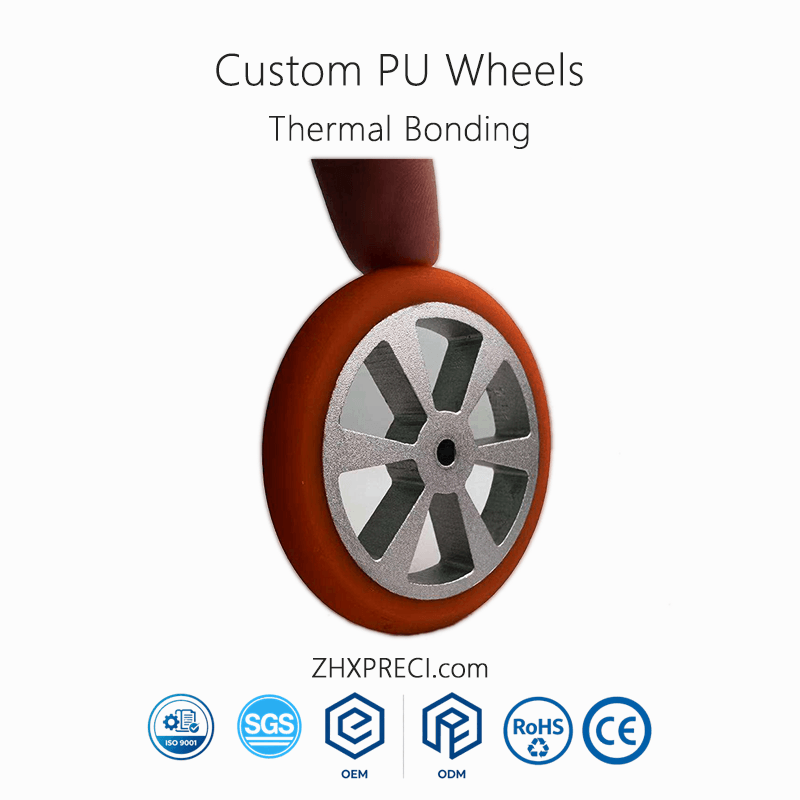
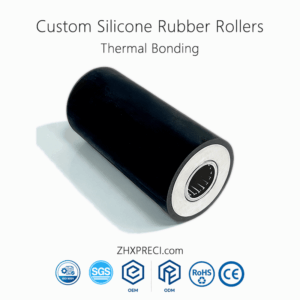
Product photos showing the tread, hub and bearing seat, together with dimension drawings for approval, are available on request. If you send us a photo of your existing bend section, we can indicate the recommended wheel position and provide a custom drawing before production.


Material Properties
The low friction behaviour of these wheels comes from the compound rather than from a surface coating, so it does not wear away after a few weeks of running. Lowering friction usually costs some grip, which is why we tune the formulation per application: sortation lines handling cartons need a different balance from pallet transfer bends carrying heavier loads.
| Property | Typical value | Test reference |
|---|---|---|
| Abrasion loss | 25 to 45 mm³ | DIN 53516, 12 N load |
| Tensile strength | 35 to 50 MPa | ISO 37 |
| Elongation at break | 400 to 550 % | ISO 37 |
| Rebound resilience | 40 to 50 % | ISO 4662 |
| Compression set | Below 25 % after 22 h at 70°C | ISO 815 |
| Tear strength | 60 to 90 kN/m | ISO 34-1 |
| Friction on dry steel | Approx. 0.15 to 0.25 | Internal test, low friction grade |
The abrasion figure matters most for conveyor bends, because the wheel is constantly scrubbing sideways against the guide rail. A compound in the 25 to 45 mm³ range keeps the tread dimension stable for a long service interval, which is usually what decides whether a curve section runs quietly or starts generating vibration after a few months.
Application Notes: Matching the Wheel to Your Curve Section
Choosing a low friction polyurethane wheel is mostly a question of balancing three factors: load per wheel, bend radius and conveyor speed. The guidance below reflects what we usually recommend after reviewing customer layouts, but your own test run on site should be the final confirmation.
- Light cartons and parcels on tight bends: Shore A 85 to 90 with a plain bore or sealed ball bearing gives the lowest drag and the smoothest product flow.
- Medium loads on wider curves: Shore A 92 with a steel or stainless hub handles side thrust better while keeping friction low.
- Heavy loads or sharp bends: a larger diameter and a slightly harder tread reduce rolling resistance; we normally ask for the load per metre and the wheel spacing before giving advice.
- Wash-down or humid environments: stainless steel 304/316 hubs and stainless bearings are the usual choice, together with a polyether based PU for better hydrolysis resistance.
- Noise sensitive lines: ground tread faces and tight OD tolerance remove the main source of wheel rumble on curve sections.
Production & Inventory Policy
Lead time: Actual lead time is influenced by raw material supply, machining capacity and seasonal peaks, so it can vary within a reasonable range. After order confirmation we provide the most accurate estimate we can and keep you updated on any change.
Stock status: We generally do not hold stock, although a small number of fast moving standard sizes are kept on the shelf; the real quantity changes with sales and production. Please contact us to confirm live availability before placing an order.
Bulk and urgent orders: For large volume or time critical projects, talk to us early about capacity and scheduling, and we will do our best to fit your timetable.
About Us
We are a China based manufacturer and supplier specialising in cast polyurethane wheels, rollers and custom technical parts, with more than a decade of production experience and a customer base that includes conveyor builders, material handling integrators and industrial distributors in Europe, North America and Southeast Asia. Our engineering team works from drawings, samples or a simple description of the application, and we support OEM, ODM and OBM projects with full documentation for the export market. Consistent quality is our top priority: drawings are confirmed before production, first articles can be submitted for approval, and every shipment is packed for long sea freight. Customers are welcome to visit our factory in China and review the production and inspection process in person.

Customers Visiting

Factory & Equipment
- In house PU casting with metering and mixing equipment, so hardness and colour are controlled at the source
- CNC turning and milling for hubs, bores and bearing seats, held to drawing tolerance
- Grinding stations for running faces and outside diameter finishing
- Bonding and curing ovens with controlled temperature cycles
- Hardness testers, abrasion tester and dimensional gauges in the QC room
- Export packing area with carton, pallet and moisture barrier preparation


Quality Control & Certifications
- ISO 9001 quality management system applied to the whole production flow
- Incoming material check on PU prepolymer and metal cores
- Dimensional inspection on the first article and on samples from each lot
- Hardness and abrasion testing recorded per batch, with retained samples
- PU compounds can be supplied RoHS and REACH compliant, with declarations on request
- Third party inspection or factory audit welcome before shipment


Frequently Asked Questions
Can you produce these low friction polyurethane wheels to our own drawing?
Yes. Send us a drawing, a sample or the key dimensions of your existing wheel, including diameter, tread width, bore, bearing type and required hardness. We confirm the specification with you before production, and OEM/ODM tooling is available for special profiles. Our engineers can also advise on the best low friction wheel for conveyor bends based on your layout. Custom colours and laser marking are also possible.
How does the low friction grade reduce drive load on a curve conveyor?
Friction between wheel and product, and between wheel and rail, is the main source of extra resistance in a bend. Our low friction compound runs at roughly 0.15 to 0.25 against dry steel in internal tests, noticeably lower than standard rubber, so the conveyor drive does not have to overcome as much drag. In most retrofits customers keep the same motor and gearbox and still see smoother product flow through the curve.
What is the minimum order quantity for custom wheels?
Standard sizes start at 100 pieces per size. For a first trial we can arrange a smaller batch so you can run the wheels on one bend before committing to volume. Wholesale pricing is available for repeat orders and annual contracts.
What lead time should we plan for?
For standard sizes with confirmed stock, dispatch is usually within 7 to 10 working days. Custom wheels normally take 15 to 25 working days after the drawing is approved, and the figure can extend during peak season or when special compounds are required. We confirm the schedule in writing with the order confirmation.
How are the wheels packed and shipped?
Wheels are packed in export cartons with moisture barrier protection, then palletised and strapped for sea freight; smaller orders can be shipped by air or express. Carton marks, labels and pallet dimensions can follow your warehouse requirements. FOB, CIF and door to door terms are all workable depending on your forwarder.
Can we get samples before mass production?
Yes. We can supply stock sizes or short run samples of the low friction grade, usually within 7 days. Sample cost is charged at production price plus freight, and it is credited back against the mass production order when the quantity meets our standard terms.
Which payment terms do you accept?
T/T with a 30 percent deposit and the balance before shipment is the most common arrangement. L/C at sight is accepted for larger orders, and other terms can be discussed for long term customers.
How do you keep quality consistent between batches?
Each batch is produced to the approved drawing and compound code, with hardness, dimensional and abrasion results recorded and retained samples kept for reference. If a batch ever falls outside the agreed tolerance, we will not ship it without discussing the deviation with you first.
Looking for a reliable manufacturing partner for conveyor bend wheels? Tell us your bend radius, load per metre and wheel position, and our engineers will provide expert advice and a custom solution, with a clear recommendation, a drawing for approval and a quotation for your project. We are glad to support you from the first sample to steady volume supply.
Reviews
There are no reviews yet.