


Description
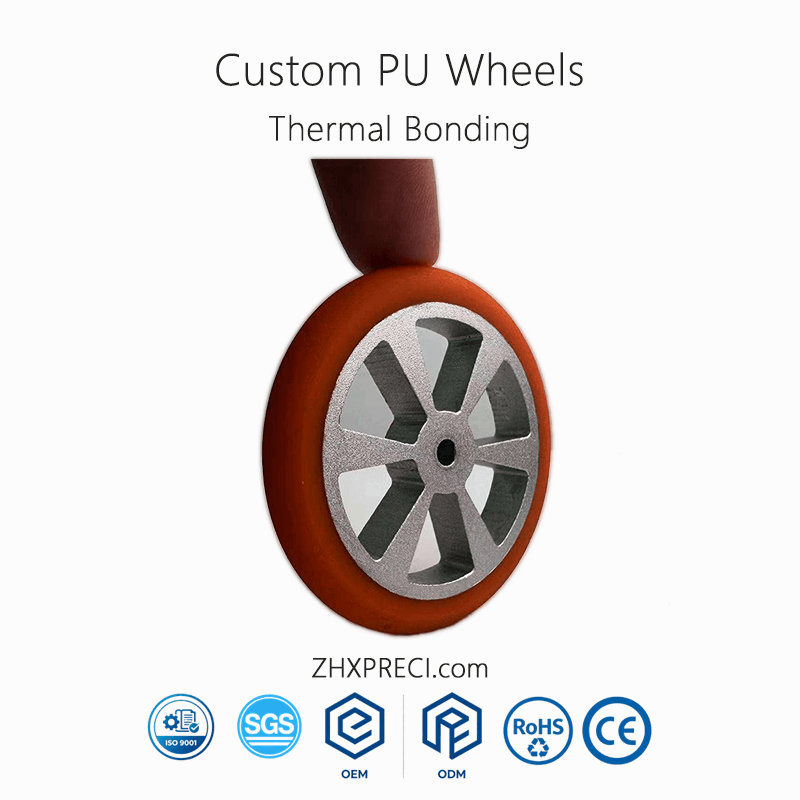
Custom Static Dissipative Polyurethane Wheels for Cleanroom Carts – Conductive PU Tread on Aluminum Alloy or 304 Stainless Steel Core, 50–500 kg per Wheel, ESD-Safe for ISO Class 5–7 Zones
Why Choose This Static Dissipative PU Wheel for Cleanroom Carts?
Cleanroom carts rarely fail because of the frame. They fail because of charge build-up, particle shedding or floor marking, and the wheel is usually where all three start. That is exactly where we put our engineering effort.
- Stable conductive path. The antistatic carbon system inside the polyurethane is controlled at the mixing stage, so each batch keeps its resistance inside 10^6 to 10^9 ohms. Charge moves off the cart steadily rather than jumping or accumulating, which protects sensitive components and reduces operator discomfort from static shocks.
- Low particle generation. A high-purity PU formulation with a low filler load keeps shedding to a minimum, so your rooms stay within ISO Class 5 to 7 limits during daily pushing and turning.
- Non-marking tread that keeps its shape. The compound resists flat spotting and leaves no black streaks on epoxy or vinyl floors, meaning fewer cleaning cycles and a floor that still looks presentable years later.
- Load capacity matched to the core. Aluminum alloy cores keep the wheel light enough for light-duty carts, while stainless steel cores carry heavier loads and resist humid or wash-down environments without corroding.
- Customization on real dimensions. Diameter from 75 mm to 250 mm, tread width from 32 mm to 75 mm, hardness from Shore A 75 to 95, plus bearing type and mounting style chosen for your existing cart design. You get one solution, not a compromise picked from a standard catalogue.
Technical Specifications – Static Dissipative Cleanroom Caster Wheel
These cleanroom caster wheels are designed for continuous cart movement in charge-sensitive areas. As a China OEM/ODM manufacturer, we support customized sizes, hardness grades and core materials to match your existing cart design.
| Custom Static Dissipative PU Wheel for Cleanroom Carts – 75–250 mm Diameter, Shore A 75–95, 10^6–10^9 Ohms (Full OEM/ODM Customization) | |
| Product type | Custom static dissipative polyurethane wheel for cleanroom carts |
|---|---|
| Tread material | Static dissipative polyurethane, antistatic compound |
| Core material | Aluminum alloy or 304 stainless steel |
| Surface resistivity | 10^6 – 10^9 ohms, narrower bands available on request |
| Tread hardness | Shore A 75 – 95 |
| Wheel diameter | 75 mm – 250 mm |
| Tread width | 32 mm – 75 mm |
| Load capacity | 50 kg – 500 kg per wheel |
| Bearing options | Precision ball bearing, stainless steel bearing, plain bore |
| Working temperature | -20 °C to +80 °C |
| Color | Black, blue, or a custom color |
| Mounting type | Top plate, bolt hole, threaded stem, expandable stem |
| Certification | ISO 9001, RoHS |
| MOQ | 50 pieces per size |
| Lead time | 15 – 30 working days after order confirmation |
| OEM / ODM | Available, including custom size, marking and packaging |
✔ Suitable for ISO Class 5–7 cleanroom carts, semiconductor wafer transfer trolleys and ESD-sensitive assembly lines. ✔ In-house antistatic compound with controlled carbon dispersion for stable resistance. ✔ Bulk orders welcome – contact us for wholesale pricing and sample support.
Details Images – Construction and Cleanroom Applications


These wheels are used wherever a cart has to move through a controlled area without generating charge or contamination. Typical installations include:
- Semiconductor wafer and cassette transfer carts running between ISO Class 5 and Class 7 zones
- Pharmaceutical dispensing trolleys and sterile supply carts in clean corridors
- Electronics assembly line carts carrying PCBs, drives and sensitive modules
- Laboratory instrument trolleys and hospital equipment frames
- ESD-protected mobile workstations in battery and display manufacturing
If your cart carries a mixed load or rolls across floor transitions, tell us the maximum load per wheel and the floor material. We will recommend a tread hardness and core combination that keeps the cart stable and the rolling effort low, rather than simply matching a diameter.
Material Properties – Static Dissipative Polyurethane Tread
These figures come from routine batch testing on our production wheels. They give a practical picture of how the tread behaves under load, at temperature, and in contact with the oils and cleaning agents found in cleanroom environments.
| Property | Typical Value |
|---|---|
| Tensile strength | ≥ 35 MPa |
| Elongation at break | ≥ 450% |
| Tear strength | ≥ 45 kN/m |
| Abrasion loss, DIN 53516 | ≤ 80 mm³ |
| Rebound resilience | 40% – 50% |
| Compression set, 70 °C × 22 h | ≤ 25% |
| Oil and grease resistance | Good |
| Static decay time | ≤ 0.5 s |
| Particle shedding tendency | Low |
A lower Shore A value gives a softer, quieter roll and better grip on smooth epoxy floors, while a higher value inside the 75–95 range carries heavier loads with less rolling resistance. Decay time is measured on finished wheels, not on raw compound, because bonding and hub assembly both influence the final conductive path.
About Us – China Factory for ESD-Safe Cleanroom Caster Wheels
About Our Factory

Visits from Overseas Buyers

We are an industrial caster and polyurethane wheel manufacturer based in China, supplying ESD-safe and cleanroom-grade wheels to distributors, equipment builders and end users worldwide. Our team has been working with polyurethane compounds for more than a decade, and cleanroom carts have been one of our focus areas since the early days of our export business.
Most of our customers come to us with a specific problem: a wheel that wears too fast, marks the floor, or drifts out of the required resistance range after a few months. We work through the load, the floor, the cleaning chemicals and the cleanliness class before quoting, because the cheapest wheel is rarely the one that lasts. That is why we offer free technical advice and a clear price suggestion up front, and we are happy to produce a small sample batch so you can test before committing to volume.
Factory and Equipment
Our production line covers the full chain from compound mixing to final inspection, which means we control the conductivity of the material rather than buying it in and hoping for consistency.
- PU casting and mixing lines with controlled carbon dispersion
- CNC machining centers for aluminum and stainless steel cores
- Hydraulic presses for tread bonding and hub assembly
- Surface resistivity test benches with controlled humidity chambers
- Hardness, tensile and abrasion testing equipment
- Dynamic balancing and rolling resistance test rigs
- Coordinate measuring machines for dimensional verification
For larger programs we can build dedicated tooling and dedicated production slots, and we welcome factory visits from overseas buyers.


Certifications and Quality Control Reports
Our facility is certified to ISO 9001:2015, and our wheels are produced in line with RoHS and REACH requirements. Every static dissipative batch is rechecked for surface resistivity, hardness and balance before shipment, and test reports can be supplied with the goods. Third-party inspection through SGS, TÜV or BV can be arranged at your request, and we are glad to work with your own inspection team if you prefer to verify before delivery.

Production and Inventory Policy
Lead time: Actual lead time depends on raw material supply, machine scheduling and peak season load, so it can shift by a reasonable margin. We will give you a realistic delivery estimate once the order is confirmed and keep you updated throughout production.
Stock status: We generally do not hold stock, though a small number of fast-moving standard sizes are kept on hand. Real stock quantities change constantly with sales and production, so please confirm current availability with our team before placing an order.
Bulk and urgent orders: For large volume or time-critical projects, talk to us early about capacity and scheduling. We will do our best to fit your timeline and tell you honestly if a date is not achievable.
Frequently Asked Questions – Static Dissipative Cleanroom Caster Wheels
1. Can you customize static dissipative polyurethane wheels to fit our own cleanroom cart design?
Yes. Diameter, tread width, hardness from Shore A 75 to 95, surface resistivity band, core material, bearing type and mounting style are all open to customization. Send us a drawing, or simply tell us your current wheel size, load per wheel and required cleanliness class, and our engineers will confirm what is feasible and quote accordingly.
2. What is the minimum order quantity for a custom size?
For standard sizes the MOQ is 50 pieces per size. A new mold or a new compound formulation requires a first article sample regardless of quantity, but from 50 to 100 pieces onward the unit pricing becomes genuinely competitive for wholesale buyers.
3. How do you control surface resistivity, and can you provide a test report?
Conductivity comes from a carbon system that is dispersed into the polyurethane during mixing. Every batch is tested in a humidity-controlled room at 100 V and 500 V, following standard practice for conductive and dissipative materials, and the report ships with the goods. If your process needs a tighter window, for example a narrower band inside the broad dissipative range, we can tune the formulation to suit.
4. Will these wheels shed particles or leave marks in the cleanroom?
Particle shedding and marking are two of the main reasons customers move away from rubber. Our tread uses a high-purity PU compound that resists abrasion and does not contain the plasticizers that cause black streaking. Under normal cart loads on epoxy or vinyl flooring, the wheels run clean and leave the floor unmarked.
5. Do you offer OEM and ODM services, including private labeling?
Yes. We can produce under your brand with custom packaging, custom printing on cartons, and your logo molded or laser-marked on the core where the design allows. OEM and ODM projects are a routine part of our export business, and we are comfortable working from your drawings or developing a solution together.
6. What are the lead time and packing options?
Standard production runs take roughly 15 to 30 working days after order confirmation, with longer times during peak season or for new tooling. Wheels are packed in PE bags, then cartons, then plywood pallets or plywood cases for sea freight. Neutral packing and branded packing are both available.
7. Which payment and shipping methods do you accept?
We normally work on a 30% T/T deposit with the balance against the bill of lading copy, and we can accept an irrevocable L/C at sight for larger orders. Sample payments are usually made through PayPal or Western Union. Shipping can be arranged by sea, by air, or by express through DHL, FedEx and UPS, and door-to-door delivery is available in most markets.
8. Is there a warranty on the wheels?
We provide a 12-month warranty covering manufacturing defects under normal use. If a wheel fails inside that period because of a bonding fault, a hardness deviation or a resistance value outside the agreed range, we will replace it or credit the value. Wear life depends heavily on load, floor condition and how the cart is used, so we prefer to agree on realistic expectations before production rather than promise a figure we cannot support.
Talk to Our Engineering Team
Looking for a reliable manufacturing partner for your cleanroom cart wheels? Get in touch for a quick quote, a custom sample, and volume pricing that works for your market. Share your drawing, load requirement and target quantity, and we will support your project from design through to delivery.
Reviews
There are no reviews yet.