


Description
Custom Swivel Lock Polyurethane Wheels for Exam Tables
Custom swivel lock polyurethane wheels for exam tables are designed for one job above all others: keeping a table absolutely still while a patient is on it, then rolling away smoothly once the examination ends. A single pedal locks the swivel and the wheel rotation at the same time, so nursing staff never have to chase a drifting couch mid-procedure. The tread is cast polyurethane rather than hard nylon or plain rubber, which gives it higher load capacity at the same thickness, noticeably quieter running and a non-marking contact that protects vinyl, epoxy and linoleum clinic floors, while the compound stays elastic enough to absorb vibration instead of passing it into the frame. Every set is produced to order in our own China factory, so wheel diameter, tread hardness, load rating, mounting plate pattern and brake colour can all be matched to the exact frame of your exam table. As a professional OEM and ODM manufacturer and supplier, we offer expert advice on load distribution and a realistic price suggestion for both sample runs and wholesale volumes, so you can weigh a custom solution against stock casters before committing to a full production batch.
Why Choose These Wheels
Most exam tables fail at the caster, not at the frame. Standard catalogue casters are often sized for general furniture and end up too soft, too noisy, or unable to hold a locked position on a slightly uneven clinic floor. Our swivel-lock polyurethane wheels were developed specifically to close that gap for medical equipment builders and hospital maintenance buyers.
- Single-action total lock. One pedal locks swivel and roll together, which removes the wobble that a swivel-only brake still allows. The table holds its position during examinations, injections and minor procedures.
- Polyurethane tread instead of rubber or nylon. Polyurethane delivers higher load capacity than rubber of the same thickness and runs far quieter than hard nylon. It also resists flattening when a table sits in one spot for weeks.
- Non-marking, floor-friendly contact. The tread leaves no black streaks on light-coloured clinic flooring, which matters for hospitals with strict cleaning and appearance standards.
- Fully customisable to your table frame. Diameter, width, hardness, bearing type, mounting plate and stem thread can all be adjusted, so you are not forced to redesign your frame around a stock caster.
- Made in our own factory, not resold. We control moulding, machining, assembly and inspection in-house, which keeps lead times predictable and lets us quote competitive wholesale prices on repeat orders.
Technical Specifications
The table below shows our typical configuration for medical exam table casters. Final values are confirmed against your drawing or sample before production begins, and our engineering team will advise on the most suitable combination for your load and floor conditions. Where a standard size does not fit, the specification is rebuilt as a fully custom part for your market.
| Parameter | Typical Configuration |
|---|---|
| Wheel type | Swivel caster with pedal-operated total-lock brake |
| Tread material | Polyurethane, Shore A 85°–95°, hardness selected to your load and floor |
| Wheel core | Machined steel or aluminium core, zinc-plated or painted finish |
| Wheel diameter | Commonly 50 mm, 75 mm, 100 mm and 125 mm; other sizes made to order |
| Load capacity | Typical 60 kg to 200 kg per wheel, depending on diameter, hardness and bearing choice |
| Brake function | Total lock — swivel and wheel rotation locked simultaneously by a single pedal |
| Bearing options | Precision ball bearing, roller bearing or plain bore |
| Mounting options | Top plate, threaded stem or bolt-hole pattern matched to your frame |
| Colour | Standard grey or black tread; custom colours available for OEM projects |
| Application | Exam tables, diagnostic couches, treatment chairs, instrument trolleys and mobile medical furniture |
| Minimum order | Negotiable — sample quantities are accepted for evaluation before volume production |
| Origin | Manufactured in our China factory, shipped worldwide |
Material Properties
Polyurethane is the reason these wheels behave differently from ordinary rubber casters on a clinic floor. The values below describe how the tread typically performs in medical furniture use, and they are the figures we work from when matching a compound to a customer. We can fine-tune hardness and additives if your environment involves heavy disinfection routines or unusually heavy static loads; the honest trade-off is that a softer tread protects floors better, while a harder tread carries more weight with less push effort, so the right answer usually sits between the two.
| Property | Typical Behaviour | What It Means in Practice |
|---|---|---|
| Hardness | Shore A 85° to 95° | Softer grades grip better and protect floors; harder grades carry more weight with less rolling effort |
| Abrasion resistance | Significantly higher than natural rubber | Longer service life on tiles and concrete, fewer replacements per year |
| Non-marking | Non-marking formulation | No black streaks on pale vinyl or epoxy flooring |
| Compression set | Low permanent deformation under static load | A locked table parked for weeks does not develop a flat spot that causes a bump when rolled again |
| Noise level | Noticeably quieter than hard nylon or steel | Reduces clatter in wards and examination rooms |
| Chemical resistance | Resistant to mild detergents, alcohol-based wipes and common disinfectants | Withstands routine clinical cleaning without cracking or softening |
| Temperature range | Commonly used between roughly −20 °C and +70 °C | Suitable for normal indoor clinical environments; contact us for cold-room or sterilisation applications |
| Rolling resistance | Low, with ball bearing fitted | Caretakers can move a loaded table with minimal effort |
Product Details and Images
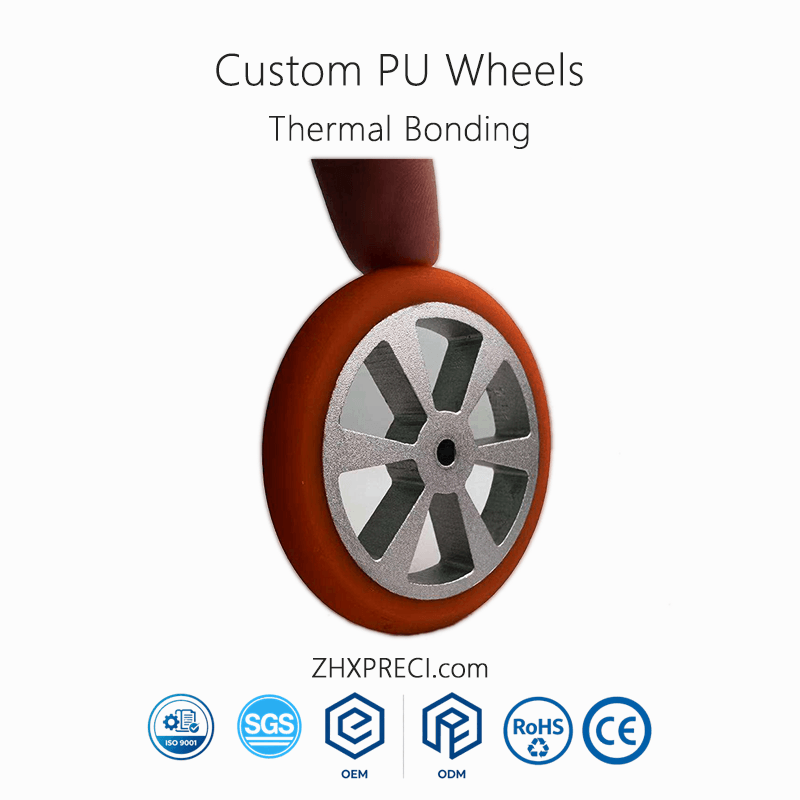
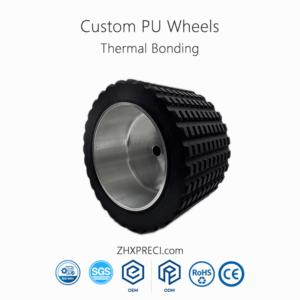
Each swivel-lock wheel is assembled from four parts you can inspect before they ever reach your floor: the cast polyurethane tyre, the machined steel or aluminium core it is bonded to, the precision bearing pressed into that core, and the pressed-steel swivel bracket carrying the total-lock pedal. The tyre is ground to a consistent crown so the load sits centrally on the tread and the wheel tracks straight instead of wearing on one shoulder. The pedal is positioned to be reachable with the side of a shoe, which matters when a nurse is steadying a patient with one hand. High-resolution detail images, sectional views of the core bonding and dimensional drawings for each diameter are available on request, and we are glad to photograph your specific production batch before it is packed for shipment.


Typical Applications
These casters are bought most often for equipment where a locked position has to survive patient movement. The list below covers the applications we build for most frequently; if your equipment sits outside it, the same wheel platform can usually be adapted.
- Examination and gynaecology tables. The total-lock pedal keeps the table from creeping during patient transfer and minor procedures.
- Diagnostic couches and imaging tables. Quiet polyurethane running lets staff reposition equipment without disrupting a room or a scan session.
- Treatment and dialysis chairs. Non-marking tread protects light flooring in high-traffic treatment bays.
- Instrument trolleys and mobile medical cabinets. Higher load capacity than rubber of the same size means fewer wheels per unit and a simpler frame design.
- Dental units and mobile examination lights. Small diameters such as 50 mm and 75 mm keep the equipment close to the floor and easy to nudge into position.
About Us
We are a China-based manufacturer and supplier of custom polyurethane wheels and industrial casters, serving medical furniture builders, equipment distributors and maintenance contractors across Europe, North America, the Middle East and Southeast Asia. Our factory has been producing polyurethane and rubber wheels for more than a decade, and a large share of our output is OEM and ODM work built to customer drawings rather than sold from stock.
What that means for you is straightforward: you are dealing with the production line, not a trading layer. Drawings, moulds, hardness specifications and inspection records stay in one place, which shortens the back-and-forth on custom projects and keeps pricing transparent on repeat orders. Our engineers are available to review your load calculation, floor type and locking requirement, and to give an honest suggestion on which polyurethane grade suits the application — including cases where a softer or harder compound than our standard would serve the global market better.

Factory, Equipment and Quality Control
Our production covers the full process: polyurethane casting and moulding, CNC machining of steel and aluminium cores, bearing assembly, brake fitting and final testing. Key equipment includes polyurethane casting lines with controlled curing temperature, CNC lathes and machining centres for core tolerances, hydraulic presses for bonding, and dynamic balancing and load test rigs for finished wheels. Because the whole sequence sits under one roof, we can hold tolerances on a top-grade custom project that would normally be split across several subcontractors.
Quality control runs at three points. Incoming steel and polyurethane raw materials are checked against specification. In-process inspection covers tread hardness, core dimensions and bonding integrity. Every finished batch is load tested and the brake mechanism is cycled repeatedly to confirm the swivel lock engages and releases reliably. Inspection records can be supplied with shipment, and third-party inspection before dispatch is welcome at your request. Our facility operates under ISO 9001 quality management, and product documentation including material certificates and RoHS statements is available for OEM projects.


Certifications and Compliance
Documentation matters when medical furniture has to clear a hospital purchasing process, so we keep the paperwork with the product rather than chasing it afterwards. ISO 9001 quality management certification covers our production system, and RoHS and REACH declarations are issued for the polyurethane compounds and metal components we use. Batch-level material certificates can be attached to the shipping documents, and we can support your own regulatory submission with dimensional reports, load test records and hardness measurements. If your market requires a specific declaration or an additional test, tell us at the quotation stage and we will confirm what is achievable before the order is placed rather than after.


Customer Visits and Factory Tours
Factory visits are welcome and, from our experience, the fastest way to settle a technical question. Buyers who have travelled to our plant have typically spent half a day walking the casting line, the machining area and the assembly and test benches, and have left with samples in hand for their own floor trials. If a visit is not practical, we are glad to arrange a live video walkthrough of the relevant production line, focusing on the process that applies to your wheel. Distributors evaluating us as a long-term supplier usually ask for both: a video walkthrough first, then a visit once a trial batch has performed well on their own equipment.

Production & Inventory Policy
Lead time: Actual lead time is affected by raw material supply, machining capacity and peak-season workload, so it does fluctuate. Once your order is confirmed we will give you the most accurate delivery estimate we can and keep you updated throughout production.
Stock status: We generally do not hold stock, though a limited number of fast-moving standard sizes may be available at any given time. Real stock quantities change constantly with sales and production, so please contact our team to confirm availability before placing an order.
Bulk and urgent orders: For large-volume or time-critical projects, please talk to us early about capacity and scheduling. We will do our best to fit your timeline and will tell you honestly if a date cannot be met.
Frequently Asked Questions
What load capacity can a custom swivel-lock polyurethane wheel for exam tables handle?
For a typical 100 mm polyurethane wheel with a ball bearing, we usually design around 100 kg to 150 kg per wheel, with higher figures possible on larger diameters and harder tread grades. The right value depends on how many wheels carry the table, the frame geometry and whether the floor is level. Send us your table weight and wheel count and we will confirm a safe working load rather than a theoretical maximum.
Can you adjust the polyurethane hardness for different exam table designs?
Yes. Shore A hardness is one of the main variables we control. Softer grades around Shore A 85° are quieter and gentler on vinyl and epoxy floors, which suits lightweight examination couches. Harder grades up to Shore A 95° carry more weight with less rolling resistance, which suits heavier diagnostic tables and mobile instrument cabinets. If your clinic runs aggressive disinfection routines, we can also discuss a compound with improved chemical resistance.
How does the total-lock brake differ from a standard swivel brake?
A standard swivel brake only stops the fork from turning, so the wheel can still roll and the table can still shift. Our total-lock pedal locks the swivel and the wheel rotation at the same time. On a slightly uneven clinic floor, that difference is what keeps an exam table from creeping while a patient is on it. The brake is released by lifting the pedal, and we test the mechanism through repeated cycles before shipment.
What wheel diameters and mounting options are available?
We commonly produce 50 mm, 75 mm, 100 mm and 125 mm diameters, with other sizes made to order. Mounting can be a top plate, a threaded stem, or a bolt-hole pattern matched to your existing frame. If you send a drawing, a sample caster or even a photograph with dimensions, we will confirm the mounting interface before tooling or production starts. This is standard practice for our OEM and ODM projects.
Can these casters be retrofitted onto an existing exam table frame?
In most cases, yes. Retrofitting usually comes down to matching three things: the mounting plate bolt pattern or stem thread, the overall height of the caster, and the load rating of the original wheel. Give us those dimensions and we will tell you whether a catalogue configuration fits or whether a custom plate is needed. For low-volume retrofit jobs we can supply a small trial set so your maintenance team can confirm the fit on a real table before ordering for the whole fleet.
What is your minimum order quantity for custom medical casters?
MOQ depends on whether the specification uses an existing mould or requires new tooling. For configurations we already produce, we accept modest trial quantities so you can test the wheels on your own exam tables before committing to volume. For a completely new tread profile or mounting plate, MOQ will be higher because of tooling cost. Tell us your target quantity and we will give you a realistic answer rather than an artificially low one.
How are the wheels packed and shipped?
Wheels are packed in cartons with internal separation to protect the polyurethane tread and the brake mechanism, then palletised for container or air freight. We can supply neutral packaging or print your own brand and carton markings for OEM orders. Shipping is arranged by sea, air or express courier depending on volume and urgency, and we will quote the most practical option for your destination.
Do you support OEM, ODM and private labelling?
Yes. A large part of our production is OEM and ODM work for medical furniture brands and equipment distributors. We can work from your drawing or from a sample, produce to your tolerance and hardness specification, and apply your branding to the product and packaging. Where a design is still open, our engineers can propose a wheel configuration based on your table weight, floor type and locking requirement — a custom solution rather than a catalogue compromise.
Which payment methods do you accept?
We normally work on a deposit plus balance before shipment, with the balance payable against a copy of the shipping documents for established customers. Common methods include bank transfer and other terms agreed at order stage. For first orders we are happy to start with a small trial batch so both sides can confirm quality and communication before scaling up.
Looking for a reliable manufacturing partner for custom swivel-lock polyurethane wheels? Get in touch for quick quotes, custom samples and volume pricing. We are happy to review your exam table drawing and suggest the most suitable wheel diameter, hardness and brake configuration for your application — from first sample to full delivery.
Reviews
There are no reviews yet.