


Description
Custom CE Certified Polyurethane Wheels for European Machinery
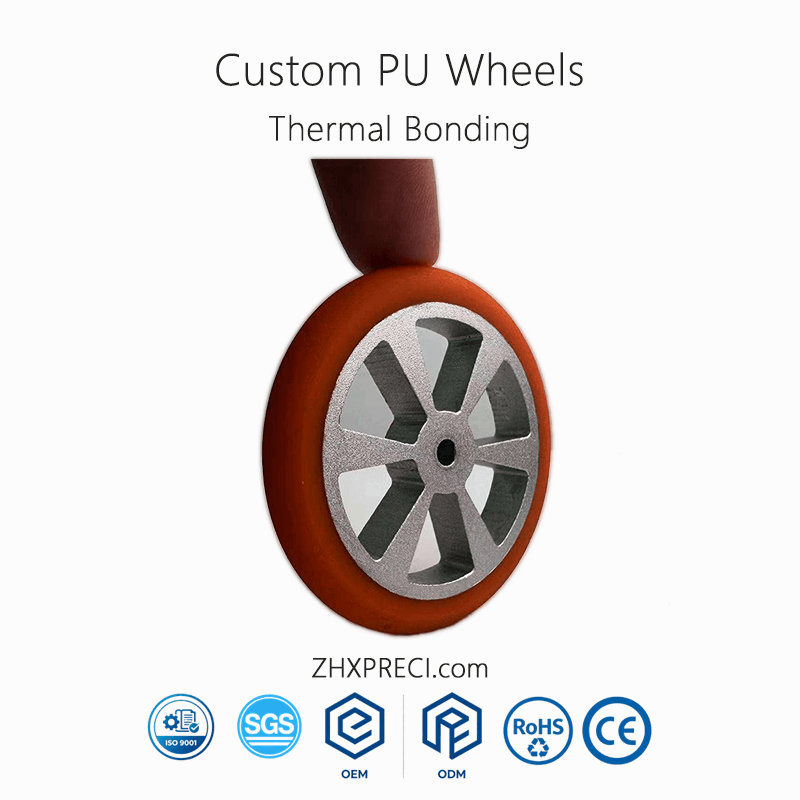
Our custom CE certified polyurethane wheels for European machinery are cast, bonded and machined in our own factory in China, which means you buy directly from the manufacturer instead of through a trading chain. Each wheel is produced to your drawing: bore and keyway size, tread profile, hardness and core material are all customized, and every batch stays traceable back to its raw material lot number. The polyurethane tread carries far more load per millimetre of width than rubber and resists cutting, oils and coolants much better than nylon, so you change wheels less often, run quieter equipment and leave fewer marks on production floors. Compared with standard stock wheels bought from European distributors, our direct-from-factory pricing, flexible minimum order quantities and full CE documentation make a professional custom solution realistic even for mid-size machine builders. As a top China OEM/ODM manufacturer and supplier, we offer expert advice, competitive price suggestions for the global market, and customized samples so you can validate performance before placing a wholesale order.
Why Choose Our Polyurethane Wheels
Documented CE compliance, not just a claim. Every shipment includes a CE declaration of conformity and a dimensional inspection report, so your technical file stays complete without extra paperwork or last-minute chasing. This matters most to machine builders who must hand over a full conformity package to their own customers.
Custom formulation as well as custom dimensions. We do not simply cut a standard compound to size. Our engineers adjust hardness from Shore A 70 to Shore D 60, change the cross-link density and, where needed, add anti-static or hydrolysis-resistant grades. A harder compound gives you a higher load rating and longer wear life under continuous running; a softer one protects delicate floors and keeps noise low in enclosed production halls.
Cores that stay bonded. Steel, stainless steel and aluminium cores are surface-treated and chemically bonded before casting, then machined after curing. This avoids the tread separation and hub slip that often appear on cheaper pressed-in wheels after a few thousand running hours, which in turn reduces unplanned downtime on your line.
Realistic engineering support. Tell us the load, running speed, floor type and duty cycle, and our technical team will give expert advice on hardness, tread pattern, bearing type and tolerance. Send a short video of the equipment in operation and we can usually recommend the right specification in one working day.
Typical Applications
- Packaging and filling lines in food, beverage and pharmaceutical plants where low marking and washdown resistance are required
- Conveyor guide and drive rollers in logistics sorting systems running continuously
- Industrial caster and drive wheels for AGVs, transfer carts and mobile work platforms
- Printing, textile and paper machinery where vibration and noise must stay under control
- Agricultural and construction equipment components that need abrasion resistance in dusty or outdoor conditions
Specifications
The table below shows our common options for custom polyurethane wheels supplied to European machinery manufacturers. Sizes, hardness and tolerances outside these ranges are regularly produced as customized items, so please send your drawing for a specific quotation.
| Parameter | Specification |
|---|---|
| Product type | Custom polyurethane wheel and roller, cast PU tread on metal core |
| Tread material | Cast polyurethane, formulation selected to application |
| Hardness | Shore A 70 to Shore D 60, customized per project |
| Core material | Carbon steel, stainless steel 304 or 316, aluminium alloy |
| Bearing options | Precision ball bearing, roller bearing, plain bore, tapered bore, keyed bore |
| Outer diameter | 50 mm to 500 mm |
| Tread width | 20 mm to 200 mm |
| Load capacity | Up to 5,000 kg per wheel, depending on diameter, width and hardness |
| Tread finish | Smooth, grooved, crowned or profiled to drawing |
| Tolerance | Typically plus or minus 0.10 mm; plus or minus 0.05 mm on request |
| Certification | CE declaration of conformity, ISO 9001:2015 factory system |
| Minimum order | 50 pieces per size as standard; trial batches from 5 pieces |
| Lead time | Usually 15 to 25 working days after drawing confirmation |
| Packing | Individual wrap, carton, plywood pallet; customized packing available |
| Customization | OEM, ODM and OBM projects, drawing or sample based |
Material Properties
The values below are typical for our standard machinery-grade polyurethane compounds. Because hardness and formulation are chosen together, the final figures for your wheel are confirmed on the batch inspection report rather than taken from a catalogue.
| Property | Typical value | Standard |
|---|---|---|
| Tensile strength | 35 to 55 MPa | ASTM D412 |
| Tear strength | 60 to 90 kN/m | ASTM D624 |
| Abrasion loss | Below 50 mm3 | DIN 53516 |
| Rebound resilience | 40 to 60 percent | ASTM D2632 |
| Compression set | Below 25 percent at 70 C for 22 h | ASTM D395 |
| Operating temperature | -30 C to +80 C, short peaks to +100 C | Internal test |
| Oil and coolant resistance | Good to excellent, grade dependent | Immersion test |
| Running runout | 0.05 mm or better after balancing | Dial gauge check |
When a wheel has to survive oily machine shop floors, a polyurethane tread keeps its shape far longer than a rubber one, and when the same wheel runs on a polished assembly floor, our softer grades keep the noise down without leaving black marks. That balance between wear life and floor protection is what our European machinery customers are usually looking for.
Elastomer Comparison for Custom Wheels
The ratings below compare the common elastomer families we work with. For heavy-duty machinery wheels, polyurethane normally gives the best combination of abrasion resistance and load bearing, which is why it is our default recommendation unless temperature or chemical exposure points to another compound.
| Compound | Hardness range (Shore A) | Abrasion resistance | Tear resistance | Load bearing |
|---|---|---|---|---|
| Silicone | 40-90 | 1 | 1 | 1 |
| Nitrile/PVC | 20-95 | 4 | 3 | 3 |
| EPDM | 20-95 | 4 | 3 | 3 |
| Nitrile rubber | 20-95 | 3 | 3 | 3 |
| Neoprene | 5-95 | 3 | 4 | 4 |
| Hypalon | 30-95 | 4 | 4 | 4 |
| Hydrogenated nitrile | 50-98 | 5 | 5 | 5 |
| Natural rubber | 25-98 | 5 | 5 | 5 |
| Polyurethane | 20-98 | 5 | 5 | 5 |
| Carboxylated nitrile | 45-95 | 5 | 5 | 5 |
Ratings: 1 = low, 5 = high. The table is a general guide rather than a specification sheet, because the real performance of a wheel depends on how hardness, core bonding and tread geometry are combined. Share your working conditions and we will recommend a specific compound and hardness instead of leaving you to guess from a chart.
Product Details and Customization
Every wheel we have for sale is produced to order rather than pulled from a generic catalogue, which is why our customers in Germany, Italy, France, Spain, the Netherlands and Poland use us as their long-term polyurethane wheel supplier. Typical customization covers hub bore and keyway dimensions, tread pattern and crowning, bearing fit, surface colour, laser-marked part numbers and individual packaging with your own label.
For customers who want to test before committing, we supply samples made on the same production line as the volume order, so the sample you approve is the wheel you receive. Prototype and small-batch runs are handled by the same engineering team that manages serial production, which keeps tolerances consistent from the first piece to the thousandth.
Details Images – Construction and Application


About Us
We are a China-based polyurethane wheel manufacturer established in 2010, focused on custom industrial wheels and rollers for machinery builders, distributors and maintenance contractors. Our in-house team covers compound formulation, metal core preparation, casting, machining, balancing and inspection under one roof, so responsibility for quality never moves between subcontractors.
Roughly 70 percent of our output is exported, with the European market taking the largest share. We work as an OEM, ODM and OBM partner: some customers send full drawings and expect us to follow them exactly, others give us only an application description and rely on our engineers to propose a cost-effective design. Wholesale pricing is available for distributors, and volume levels are discussed openly rather than hidden behind a generic price list.
Factory Overview

Customers Visiting

Factory and Equipment
Our production area covers casting and curing lines, CNC lathes and machining centres, cylindrical grinding equipment, bearing press-fit stations and dynamic balancing benches. Inspection is carried out with hardness testers, bore gauges, coordinate measuring machines and a load test bench that runs wheels under rated load before shipment.
Annual capacity is around 300,000 pieces, which lets us hold reasonable scheduling flexibility for both repeat programmes and one-off custom orders. When a project needs a special core grade or a compound we do not cast in-house, we say so at quotation stage and plan the sourcing lead time into the schedule instead of surprising you later.


Certifications and Quality Control
Our factory operates an ISO 9001:2015 quality management system, and the polyurethane wheels supplied to European machinery customers are issued with a CE declaration of conformity. Material certificates, RoHS and REACH statements are available on request, and third-party inspection by SGS, TUV or your own inspector is welcome before shipment.
Incoming metal cores, polyurethane raw materials and finished wheels are all inspected against written criteria. Hardness, bore diameter, runout and appearance are checked on every batch, and a sample from each batch is run on the load bench. Records are kept for two years so that any later question about a specific delivery can be answered with real data.

Production and Inventory Policy
Lead time: Actual lead time is affected by raw material supply, machining capacity and peak-season workload, so it can vary within a reasonable range. Once your order is confirmed we will give you the most accurate delivery estimate we can and keep you updated if anything changes.
Stock status: In principle we produce to order and do not hold finished stock. A limited number of fast-moving standard sizes are kept on the shelf, but the quantity available changes constantly with sales and production. Please contact us before ordering to confirm real-time stock for those items.
Bulk and urgent orders: For large volume or time-critical projects, please talk to us early about capacity and scheduling. We will do our best to fit your timeline and will tell you clearly if a date cannot be met.
Frequently Asked Questions
Can you manufacture polyurethane wheels to our own drawing or sample?
Yes. Most of our orders are fully customized rather than catalogue items. Send a 2D drawing, a 3D model or a physical sample, and our engineers will confirm core material, bore tolerance, hardness and tread profile before quoting. Drawings are treated as confidential and we can sign an NDA before you release them.
How do we choose the right hardness for our application?
Shore A 80 to 95 is the usual starting point for general machinery and material handling wheels because it balances grip with wear resistance. For heavy loads or floors with swarf and debris, a harder Shore D compound normally lasts longer. For low-noise, non-marking use in food plants or hospitals, a softer 70 to 80 Shore A grade is often the better choice. Give us your load, running speed and floor condition and we will make a clear suggestion.
Are these wheels CE certified, and what documents come with an order?
These custom CE certified polyurethane wheels for European machinery are supplied with a CE declaration of conformity, a dimensional inspection report and a material certificate for the polyurethane compound. RoHS and REACH statements can be added at no extra cost, and pre-shipment inspection by your own team or a third party such as SGS or TUV is always welcome.
What is your minimum order quantity, and can we order a trial batch first?
The standard minimum is 50 pieces per size, but trial batches of 5 to 20 pieces are routine for new customers who want to validate performance on a real machine before committing to volume. For wholesale programmes and OEM contracts the quantity is negotiable, and unit price improves clearly at the 500-piece and 2,000-piece levels.
How long does production and delivery take?
Typical production time is 15 to 25 working days after drawing confirmation and deposit. This can extend during peak season or when a specific core grade has to be sourced, and we will tell you that at quotation stage rather than after the order is placed. Both air and sea freight are available, and for urgent projects we can sometimes split shipments.
How are the wheels packed for export?
Standard export packing is individual wrapping plus carton, then plywood pallet with strapping and moisture protection. We can print your own label, part number or handling marks on the carton and pallet, and pack to a specific warehouse standard if you have one.
What payment methods do you accept?
Bank transfer with 30 percent deposit and the balance against a copy of the bill of lading is the most common arrangement. We also accept L/C at sight, and other terms can be discussed for long-term partners.
Do you test the wheels before shipping?
Yes. Hardness, bore diameter, runout and appearance are checked on every batch, and a sample from each batch is run on our load test bench at rated load. The test records are kept for two years and can be shared with you on request.
Can you provide a custom solution for high-load or high-speed machinery applications?
Yes. As a professional China manufacturer with OEM, ODM and OBM experience, we regularly build custom solutions above the standard 5,000 kg load rating or with tighter tolerances for high-speed running. Share your load, speed and mounting details and our engineers will advise on hardness, core grade and bearing selection within one working day.
Talk to Our Engineering Team
Looking for a reliable manufacturing partner for custom polyurethane wheels? Whether you need a small trial batch or a full OEM programme for European machinery, we can provide quick quotes, customized samples and wholesale pricing for the global market. Send us your load, speed and mounting details, and you will receive a professional suggestion from our engineers within one working day.
Reviews
There are no reviews yet.