


Description
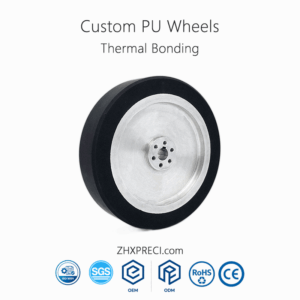
Custom Small Diameter Polyurethane Wheels for Watchmaking
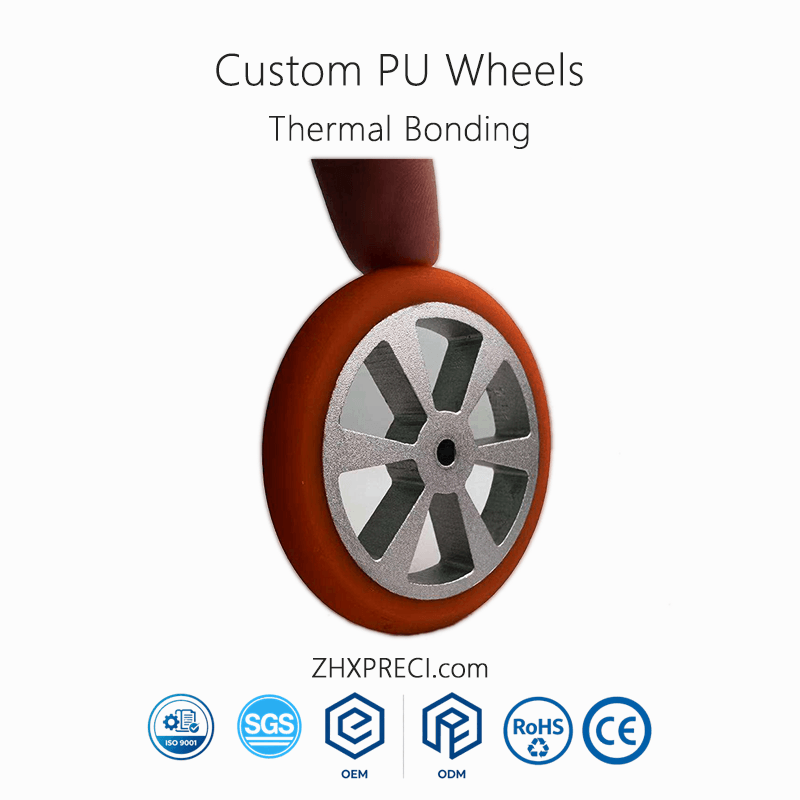
These custom small diameter polyurethane wheels are built for watchmaking benches where a few hundredths of a millimetre decide whether a bezel comes out flawless or scratched. We machine and cast PU wheels from Ø6 mm up to Ø40 mm, with bore tolerances held to ±0.02 mm and radial runout kept within 0.05 mm, so they run true on polishing spindles, lapping fixtures, movement transfer rails and case-feeding tracks. Because the tread is a cast polyurethane rather than a rubber compound, the wheel grips quietly, resists watchmaking oils and cleaning solvents, and leaves no dark residue on brushed or polished cases. Each batch is checked against your drawing before packing, which is how our OEM customers in Switzerland, Japan and Shenzhen keep their assembly lines running without surprise rejects. As a China-based manufacturer and supplier shipping direct, we quote wholesale prices without trading-company markup and support full customization, from hardness and colour to hub design and bore keyway. Our engineers are happy to give expert advice on the right hardness, hub and bore combination for your application.
Why Choose These Custom Small Diameter Polyurethane Wheels
Watchmaking equipment punishes ordinary rollers. A wheel that is a fraction too hard polishes through a case edge, one that is too soft deforms and throws the workpiece off centre, and one that sheds particles contaminates a clean assembly bench. The design brief here is narrow by intention: a controlled, repeatable contact point at very small diameters.
- Cast polyurethane tread instead of rubber. Polyurethane holds its shape under continuous light load far better than a soft rubber tread, so the contact patch stays constant through a long polishing shift. That means your operator does not have to re-zero the fixture halfway through the day, and scrap from inconsistent pressure drops accordingly. Our own abrasion testing on the Shore A 90 formulation shows roughly three times the wear life of a comparable nitrile rubber tread under identical spindle conditions.
- Tight bore and runout control. Bores are reamed to ±0.02 mm and radial runout is verified at 0.05 mm on a dial indicator before dispatch. A wheel that runs true does not vibrate, and a non-vibrating spindle is what keeps a polished surface free of chatter marks. Every shipment carries an inspection record tied to your drawing revision.
- Non-marking, low-particle finish. The tread is turned or ground to a fine matte finish and can be supplied in natural, white or a light blue tint. It will not leave the black rubber smears that plague watch case handling, which matters when a returned case has to be re-polished at your cost rather than ours.
- Chemical and oil resistance. Bench environments involve cleaning solvents, lubricating oils and ultrasonic baths. Our PU grade is formulated for these exposures and keeps its hardness within a narrow band across a -20 °C to +80 °C working range, so performance on the bench matches the specification sheet.
- Direct factory pricing and full customization. Because the wheels are made in our own workshop rather than sourced through a trading company, you pay for the part, not the layer of middlemen. Sizes, hardness, hub material, bore diameter and colour are all custom options, and our engineers will give you practical advice on which combination suits your spindle speed and workpiece weight.
Technical Specifications
Use this table as a starting point rather than a limit. Most watchmaking applications sit between Ø8 mm and Ø25 mm with a Shore A 70 to 95 tread, but if your fixture needs a customized bore, a stainless steel insert or a crowned profile, our technical team will confirm feasibility before quoting. Sending a drawing or a worn sample usually shortens the discussion considerably.
| Parameter | Specification |
|---|---|
| Product type | Custom small diameter polyurethane wheel for watchmaking and precision assembly |
| Outer diameter | Ø6 mm to Ø40 mm, made to drawing |
| Wheel width | 3 mm to 20 mm |
| Bore diameter | 1.5 mm to 12 mm, tolerance ±0.02 mm |
| Tread material | Cast polyurethane, custom formulation |
| Hardness | Shore A 60 to 95, single batch consistency within ±3 Shore A |
| Hub / core options | Full polyurethane, stainless steel, aluminium or POM insert |
| Tread finish | Fine turned, ground or matte, non-marking grade available |
| Radial runout | ≤ 0.05 mm on standard sizes |
| Colour | Natural, white, blue, black or custom matched |
| Working temperature | -20 °C to +80 °C |
| Typical load per wheel | Up to 15 kg depending on diameter and hardness, to be confirmed per application |
| Minimum order quantity | 50 pcs per size, lower for trial samples |
| Lead time | 10 to 20 working days after drawing and sample approval |
| Packaging | Individual PE bag, then carton with size and batch labels |
Product Details Images
Close-up views of the tread, bore and hub options help confirm what the drawing will look like in production. Send us your dimensions and we will match the hub style, hardness and finish to your watchmaking fixture.


Material Properties and Hardness Selection
Hardness is the single decision that changes performance most in watchmaking use, and it cannot be corrected after moulding. The table below condenses what we have learned from production runs for jewellers, movement makers and case-polishing workshops. Treat the boundaries as guidance, not hard lines; a Ø10 mm wheel and a Ø30 mm wheel at the same Shore A value behave quite differently because the contact area differs.
| Hardness | Behaviour | Typical watchmaking use |
|---|---|---|
| Shore A 60–70 | Soft contact, high conformity, lowest marking risk, faster wear under continuous rotation | Case polishing and buffing support, delicate lacquer or PVD surfaces |
| Shore A 75–85 | Balanced grip and dimensional stability, good compromise for mixed workloads | Movement transfer rails, case feeding tracks, general benchtop fixtures |
| Shore A 90–95 | High load capacity and abrasion resistance, minimal deformation, firmer contact point | Lapping and grinding fixtures, spindle drive wheels, high-cycle automation |
Values are measured on finished parts at 23 °C. Actual wear life also depends on spindle speed, contact pressure and the cleanliness of the working environment, so we recommend a trial batch before full production on a new fixture design.
Where These Wheels Fit on a Watchmaking Bench
- Case and bezel polishing fixtures: the wheel drives or supports the case without scuffing brushed finishes or leaving rubber transfer marks.
- Movement transfer and feeding rails: small diameters allow tight radius turns on automated transport lines while keeping noise below the level of standard rubber rollers.
- Lapping and grinding jigs: the higher Shore A grades hold their profile under continuous contact, which keeps the finished surface flat and repeatable.
- Sub-assembly and inspection stations: non-marking treads protect parts that will be visually inspected and packed without re-cleaning.
- Bracelet and strap processing equipment: flexible treads conform to curved link profiles without deforming the part.
Factory & Equipment
Our workshop combines CNC turning, in-house polyurethane casting and a dedicated inspection room. That setup gives us direct control over bore accuracy, tread finish and batch consistency, which is important for small wheels used in watchmaking and precision assembly. If you are evaluating suppliers, we can share practical details about our machining and inspection process before you place an order.


Customer Visits
We welcome customer visits to review drawings, samples and inspection records in person. For overseas buyers, a visit is also a useful way to discuss custom hardness options, hub materials and production scheduling with our engineering team.

Certificates
We operate to ISO 9001 quality management practices and can supply material certificates, batch inspection records and dimensional reports with the shipment. These documents help your incoming quality team verify the parts without additional testing.


About Us
We are a China-based manufacturer and supplier of custom polyurethane wheels and precision polymer components, working with watchmaking, medical device and small automation customers since 2010. Our workshop combines CNC turning, in-house PU casting and a dedicated inspection room, and we operate to ISO 9001 quality management practices with export experience across more than 30 countries. Whether you need OEM, ODM or OBM support, our team can act as your professional custom solution partner for the global market, using top-quality PU raw materials and tight process control.

Our engineers spend most of their time on exactly the kind of small-part problem this page describes: a wheel that is a little too hard, a bore that runs a few microns out, a tread that marks a finished surface. If you are comparing suppliers, we are glad to give you a professional opinion on your drawing, an honest suggestion on hardness, and a transparent price indication for the volume you have in mind — even if the answer is that a standard part will serve you better than a custom one.
Production and Inventory Policy
Lead time: Actual lead time depends on raw material supply, machining capacity and seasonal workload, so it moves within a reasonable range. Once your order is confirmed we will give you the most accurate delivery estimate we can and keep you informed of any change.
Stock status: We do not hold stock as a rule, although a small number of fast-moving standard sizes are kept on the shelf. The real quantity of those items changes with sales and production, so please confirm current availability with our team before placing an order.
Bulk and urgent orders: For large volumes or tight deadlines, talk to us early about capacity and scheduling. We will do our best to fit your timeline, and we would rather tell you honestly what is achievable than promise a date we cannot hold.
Frequently Asked Questions
Can you produce custom small diameter polyurethane wheels to our own drawing?
Yes. Customization is the core of what we do, and most orders start from a customer drawing, a 3D file or a worn sample. Send the outer diameter, bore, width, hardness and the hub material you prefer, and we will confirm feasibility, propose tolerances and quote. For very small diameters below Ø8 mm we usually recommend a full polyurethane body or a POM insert, because a stainless steel core can be difficult to bond reliably at that scale.
How do we choose the right Shore A hardness for a watchmaking fixture?
Start from the surface you are protecting. Polished or PVD-coated cases usually call for Shore A 60 to 70 to avoid marking, while lapping and spindle drive applications normally need Shore A 90 or above to resist deformation. For a typical Ø10 mm transfer wheel we usually suggest Shore A 80 as a starting point, then adjust after a trial. Our engineers will give you a specific recommendation if you tell us the spindle speed, the part weight and whether the wheel is driving or idling.
Will the polyurethane tread leave marks or scratches on watch cases?
The tread is formulated as a non-marking grade and finished to a fine matte surface, so it does not leave the black transfer marks common with rubber rollers. It is still a polymer in contact with a finished surface, so we recommend a short trial on your actual workpiece before full production, particularly on high-gloss or lacquered finishes. Where the risk is highest, we can supply an even softer compound or a polished tread finish.
What is the minimum order quantity, and can we get samples first?
Standard MOQ is 50 pieces per size, and we accept smaller trial quantities for first orders so you can test the wheel on your own fixture. Sample lead time is normally 7 to 12 working days, and the sample cost is usually credited against your first production order. We ship samples worldwide by express courier.
How long does production take after approval?
For a confirmed drawing and approved sample, production typically runs 10 to 20 working days depending on quantity and whether the hub insert is a standard or newly machined part. This is an estimate rather than a fixed commitment, since material batches and workshop scheduling can shift it slightly. We will give you a firm production date when the order is placed and flag any change as soon as we see it.
How do you control dimensional accuracy on such small parts?
Bores are reamed and checked with pin gauges and a bore micrometer, outer diameters are verified on a dial indicator, and radial runout is measured on a dedicated spindle fixture. Each batch is sampled against your drawing revision and the record is kept with the shipment. For watchmaking customers we can include the inspection report with the packing list on request.
What payment and shipping terms do you work with?
We normally accept T/T with a deposit on order and the balance before shipment, and we can discuss other terms for repeat customers. Shipping is by air express for small and urgent batches, and by sea or rail for larger volumes; we will quote the option that fits your delivery window and mark the cartons with size and batch labels so your warehouse can put them away without re-labelling.
How does wholesale pricing work for custom small polyurethane wheel orders?
Pricing depends on diameter, hardness, hub material, tolerance and order quantity. We quote ex-works or with shipping as you prefer, and we keep the price structure transparent so you can compare options. For repeat OEM, ODM or OBM programs we review the price at each volume tier; small trial orders are also welcome so you can test the wheel before committing to a larger production run. These wheels are for sale at wholesale prices, and our team can give you a clear suggestion on the most cost-effective specification for your market.
Looking for a manufacturing partner who can turn a small polyurethane wheel around quickly without cutting corners on tolerance? Send us your drawing and the quantity you have in mind, and we will come back with a clear quote, a hardness suggestion and sample options. We are happy to support your project from the first sketch through to repeat production.
Reviews
There are no reviews yet.