


Description
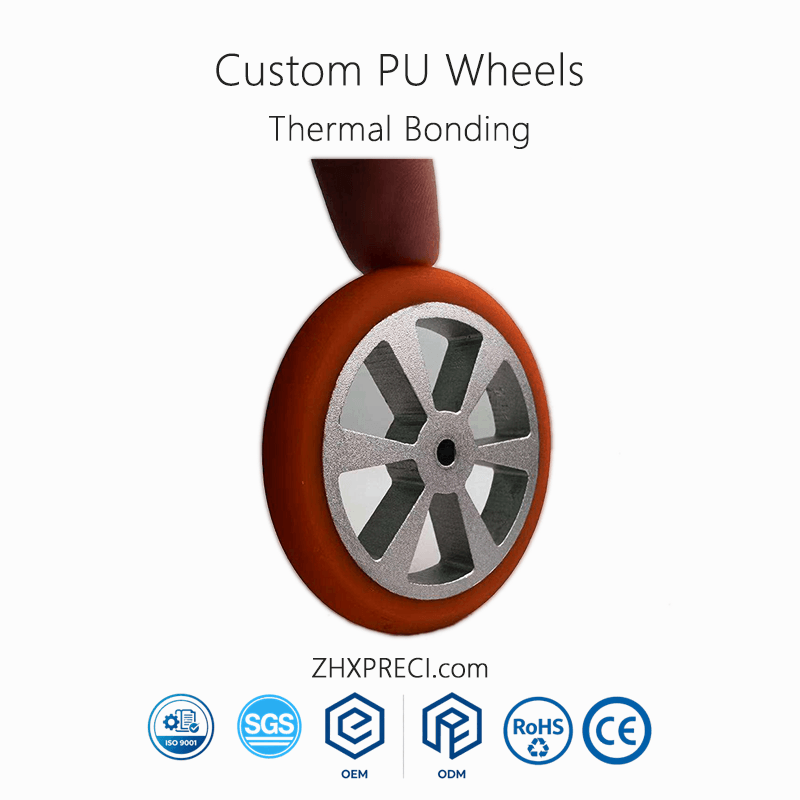
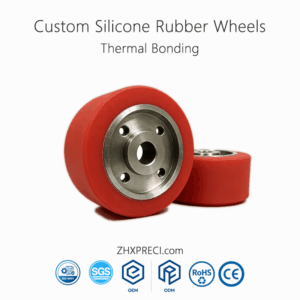
Custom Threaded Axle Polyurethane Wheels for Roller Dies
Our custom threaded axle polyurethane wheels are engineered specifically for roller die units that demand accurate tracking, high load capacity and a long, predictable service life. Made in our own factory in China, each wheel pairs a precision-machined steel, stainless steel or aluminum alloy core with a cast polyurethane tread, cured under controlled temperature so that hardness, rebound and bond strength stay consistent from the first piece to the last. Compared with standard rubber, nylon or generic stock rollers, the polyurethane tread resists abrasion, oils, greases and compression set far better, which keeps your roller die seated correctly, holds die pressure steady and cuts unplanned downtime on the line. As a top professional custom solution supplier in China, we supply these wheels as a full OEM/ODM customization service — axle diameter, thread pitch, thread direction, wheel width, hardness from Shore A 70 to Shore D 65 and even colour can all be matched to your drawing or sample — so you receive a drop-in part rather than something you have to rework. Every batch is dimensionally inspected, hardness tested and run-out checked before shipment, backed by our ISO9001 quality system and more than a decade of export experience serving industrial buyers across Europe, North America, Southeast Asia and the Middle East.
Key Advantages at a Glance
- Fully customized threaded axle, machined to your drawing in metric or imperial threads
- Cast polyurethane tread bonded to a steel, stainless steel or aluminum core
- Tunable hardness from Shore A 70 to Shore D 65 for different die pressures
- Consistent hardness, diameter and run-out from batch to batch
- OEM, ODM and OBM cooperation with realistic lead times and clear pricing
Why Choose Our Custom Threaded Axle Polyurethane Wheels
Buyers who come to us usually have one problem in common: the wheel on their roller die is either wearing out too fast, running off-centre, or simply unavailable in the exact thread and width they need. We solve that by building the wheel around your specification instead of asking you to adapt to a catalogue size. Because we control casting, machining, bonding and inspection under one roof, we can adjust hardness, profile and axle geometry quickly and quote a realistic price for the volume you actually run.
- Threaded axle machined to your drawing — metric or imperial threads, left-hand or right-hand, with the pitch and shoulder dimensions you specify, so the wheel screws directly onto your roller die shaft with no adapters and no wobble.
- Cast polyurethane tread with a strong core-to-tread bond — the elastomer is chemically bonded and mechanically locked to the hub, which prevents the tread from slipping or de-laminating under repeated load cycling.
- Tunable hardness for different die pressures — softer compounds absorb vibration and protect delicate surfaces, while harder compounds carry heavier loads and resist deformation; we help you choose based on your load and speed.
- Consistent batch-to-batch quality — controlled curing plus hardness and dimensional inspection on every lot means the twentieth order behaves like the first one.
- Straightforward OEM/ODM cooperation — send a drawing, a sample or even a worn-out original, and our engineering team will confirm feasibility, propose a material, and supply a quotation with lead time.
- Export-ready packing and documentation — carton and pallet packing as standard, with commercial invoice, packing list and certificate of origin prepared for smooth customs clearance.
In short, the feature is a fully custom threaded wheel; the advantage over stock rollers is fit, bond strength and material consistency; the benefit for you is less downtime, fewer rejects and lower total cost per die cycle. The evidence sits in our inspection records, our ISO9001 quality system and the repeat orders we receive from roller die manufacturers and metal forming shops worldwide.
Technical Specifications
The table below shows our regular capability range for roller die threaded axle wheels. Values outside these ranges are often possible — please share your drawing and we will confirm with our technical team before quoting.
| Parameter | Specification |
|---|---|
| Product type | Custom threaded axle polyurethane wheel for roller dies |
| Tread material | Cast polyurethane, polyester or polyether based, selected for your operating environment |
| Hardness range | Shore A 70 up to Shore D 65 |
| Core material | Carbon steel, stainless steel or aluminum alloy |
| Axle type | Threaded shaft, custom machined to drawing |
| Thread standard | Metric M8 to M30, or imperial UNC / UNF, left-hand or right-hand |
| Wheel diameter | 30 mm to 300 mm, custom sizes available |
| Tread width | 10 mm to 100 mm, custom widths available |
| Load capacity | Up to 2,000 kg per wheel, depending on diameter, width and hardness |
| Operating temperature | -30 °C to +80 °C; short peaks above this range on request |
| Tolerance | Diameter ±0.1 mm, radial run-out ≤0.05 mm on standard grades |
| Tread profile | Flat, crowned, grooved or rounded edge, machined or ground after curing |
| Customization | OEM / ODM / OBM, drawing-based or sample-based development |
| Minimum order quantity | 50 pieces per size; smaller trial quantities negotiable |
| Packing | Carton plus pallet as standard, or packed to your requirement |
| Typical lead time | Usually 15 to 30 days after order confirmation, subject to material supply and production schedule |
Details Images – Construction & Application
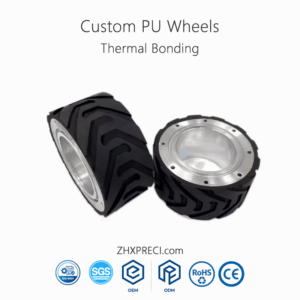
Below are detail views showing the construction, tread finish and application of our custom threaded axle polyurethane wheels for roller dies.


Material Properties and Performance
The figures below describe how our polyurethane tread behaves in practice. They are typical values from our own testing and supplier data sheets, and they help explain why a polyurethane wheel usually outlasts a plain rubber roller in roller die service.
| Property | Typical Value | What It Means for You |
|---|---|---|
| Abrasion resistance | Low volume loss, typically under 60 mm³ in standard abrasion testing | Longer tread life in continuous contact with dies and formed parts, so fewer replacements |
| Compression set | Under 20% after 24 hours at 70 °C | The wheel keeps its shape and working height over long production runs |
| Oil and grease resistance | Good with polyester-based polyurethane | Suitable for metal forming shops where lubricants and coolants are present |
| Tear strength | Typically 40 kN/m or higher | Resists edge chunking and cracking at grooves and shoulders |
| Rebound resilience | Approximately 40% to 60% | Absorbs shock and helps reduce noise and vibration around the die |
| Hardness consistency | Within ±3 Shore A inside one batch | Predictable die pressure and alignment, fewer adjustments between shifts |
| Temperature range | -30 °C to +80 °C in continuous service | Covers most workshop, warehouse and outdoor installation conditions |
| Load bearing | Up to 2,000 kg per wheel depending on size and hardness | One wheel geometry can be scaled across light and heavy roller die stations |
Product Details and Manufacturing Process
Every wheel is produced to order rather than pulled from a shelf. We start with a machined steel, stainless steel or aluminum hub, prepare the bonding surface, then cast the polyurethane tread under vacuum to eliminate trapped air and porosity. After curing, the wheel is turned and, where required, ground to final diameter and concentricity. The threaded axle is then machined, checked against your drawing with thread gauges, and protected against corrosion before final inspection.
Detail views of a finished wheel normally show the following points, which we are happy to document with photographs or video for your engineering team before shipment: the machined thread form and shoulder face that seat against your shaft; the smooth transition between core and tread, where a clean radius avoids stress concentration; the tread surface finish, which can be machined for grip or ground for low rolling resistance; and the side face run-out, measured to keep the wheel spinning true at production speeds.
Because the axle thread is the part that most often causes a return, we gauge every threaded shaft and record the result in the inspection report that accompanies the shipment. If you are replacing an imported wheel that is difficult or expensive to source, sending us the original part is usually the fastest route to a working alternative.
Product Photos, Customer Visits and Factory Tour
Before shipment we can share detailed photographs and short video clips of a finished custom threaded axle polyurethane wheel, covering the machined thread, the bonded core-to-tread junction, the tread finish and the measured run-out. Factory photos of the core machining, casting and curing, finishing and inspection areas are also available on request, so you can see where your wheels are actually made.
Customers and trading partners are welcome to visit our plant in China by appointment. Many buyers combine a factory tour with a pre-shipment inspection of their roller die wheels, and we are glad to arrange samples, inspection records and documentation on the same day. If travel is not practical, we can arrange a live video walkthrough of the production line and the inspection station instead.
About Us


We are a China-based manufacturer and supplier specializing in custom polyurethane wheels, rollers and industrial caster components. For more than a decade we have served equipment builders, roller die makers and material handling companies that need parts made to their own drawings rather than selected from a catalogue.
Our strength lies in combining polymer know-how with conventional machining. We advise on hardness, compound family and profile based on your load, speed and environment; we produce the core, cast and bond the tread, and finish the threaded axle in-house; and we inspect the finished wheel against the same drawing we quoted from. For buyers, that means one point of contact from enquiry to delivery, a clear price for the volume you run, and a partner who understands that a roller die wheel is a functional component, not a commodity item.
We work with customers across Europe, North America, Southeast Asia, the Middle East and Latin America, and we are comfortable with OEM, ODM and OBM arrangements. Whether you need a small trial batch to validate a design or a repeating wholesale programme with scheduled shipments, we can structure the order to suit your market and your cash flow.
Factory, Equipment and Quality Control
Our production site in China covers more than 8,000 square meters and is organized into four main areas: core machining, polyurethane casting and curing, finishing and inspection, and packing.
- Core machining area — CNC lathes and machining centres produce hubs, threaded axles and shoulders to the tolerances required for a true-running wheel.
- Casting and curing area — vacuum casting equipment plus temperature-controlled curing ovens, which is where hardness consistency and bond strength are established.
- Finishing area — turning, grinding and profiling equipment to bring the tread to final size, concentricity and surface finish.
- Inspection area — hardness testers, thread gauges, micrometers, dial indicators and a dynamic balance station for wheels that run at higher speed.
- Packing area — carton and pallet packing, with labelling and documentation prepared to your requirements.
Production Equipment


Visits from customers and trading partners are welcome by appointment. Buyers who have walked our floor usually comment on two things: how much of the process happens in-house, and how much of the inspection data we are willing to share. We treat both as normal practice rather than a favour.
Certifications and Testing
Our quality management system is certified to ISO9001, and we can supply a range of supporting documents with your order, including material certificates for the polyurethane compound and the core steel, hardness test records, dimensional inspection reports and thread gauge results. For customers who require third-party verification, we cooperate with nominated inspection agencies and can arrange pre-shipment inspection at our facility.


We prefer to describe performance honestly rather than promise perfection. Wear life depends on load, speed, surface condition, temperature and the presence of chemicals. If you share your working conditions, we will recommend a compound and hardness that give a realistic service life, and we will tell you when a different material would be the better engineering choice.
Production and Inventory Policy
Lead time: Actual lead time is affected by raw material supply, machining capacity and peak season workload, so it can vary within a reasonable range. Once your order is confirmed, we will give you the most accurate delivery estimate we can and keep you informed of any change as soon as it appears.
Stock status: We generally do not hold finished stock, though a limited number of fast-moving regular sizes may be available. Real stock levels change constantly with sales and production, so please contact our team to confirm availability before placing an order.
Bulk and urgent orders: For large volumes or tight deadlines, please talk to us early about capacity and scheduling. We will do our best to fit your timeline and, where that is not possible, tell you clearly rather than overpromise.
Frequently Asked Questions
Yes. Drawing-based and sample-based production is our normal way of working. Send us a PDF, DXF or STEP file, or ship us a sample or worn original, and our engineering team will review the thread specification, core material, hardness and tread profile, then come back with a feasibility comment and a quotation. If something in the drawing is difficult to produce or would perform poorly in service, we will say so and suggest an alternative.
Our standard minimum is 50 pieces per size, which keeps tooling and setup costs reasonable for both sides. For a first trial or a design validation run we can often accept smaller quantities, especially when the geometry is close to something we already produce. Please tell us your target quantity and we will confirm the most practical arrangement.
For a new custom size, typical production time is around 15 to 30 days after order confirmation and receipt of a clear drawing, allowing for material preparation and curing. Repeat orders often move faster. Actual timing depends on raw material availability, current machine load and season, so we always confirm a specific estimate with your order rather than quoting a fixed promise.
As a general guide, softer compounds in the Shore A 70 to 90 range give better grip and vibration damping, while harder grades from Shore A 95 upward to Shore D 65 carry heavier loads and deform less under pressure. For a high-load roller die that also needs some shock absorption, many customers settle in the Shore A 90 to 95 band. The right answer depends on load per wheel, running speed, surface condition and temperature, so we prefer to review your conditions before recommending a hardness — a wheel that is too hard can damage the die or the workpiece, and one that is too soft may deform and lose die pressure.
Yes. We regularly machine UNC and UNF threads as well as metric threads, in both left-hand and right-hand configurations. If you are replacing an imported wheel, please include the thread callout, the thread length and the shoulder diameter in your enquiry, or simply send the original part. We will match it and confirm the gauging method used for inspection.
Our factory operates under an ISO9001-certified quality system. Each batch is checked for hardness, diameter, width, radial and side run-out, and thread fit, with results recorded in an inspection report. On request we can also supply material certificates for the polyurethane compound and core material, hardness test records, and third-party pre-shipment inspection through an agency of your choice. We are happy to share sample reports before you place a first order.
We commonly work on T/T and L/C terms, and other arrangements can be discussed for repeat customers. For shipping we can quote EXW, FOB, CIF or DDP depending on your preference, and we ship by sea, air or international express. Wheels are normally packed in cartons on pallets; for larger orders we can use plywood cases or add edge protection if your handling equipment is rough. Let us know your destination port or city and we will include a shipping estimate in the quotation.
We stand behind our workmanship and materials. If a wheel fails to meet the agreed drawing or shows a manufacturing defect such as a de-bonded tread or a thread that does not gauge correctly, we will replace it or credit it after reviewing the evidence with you. Wear-related life is not a defect, since it depends heavily on operating conditions, but we will help analyse a premature failure and recommend a compound or hardness change if the application calls for it.
Yes, and we usually recommend it for new designs. A trial batch lets you test the thread fit, hardness and tread profile on your actual roller die before committing to a larger run, and it lets us confirm the drawing is interpreted the same way on both sides. Trial quantities and pricing are negotiable — just describe your project and we will propose something sensible.
Looking for a Reliable Manufacturing Partner for Your Roller Die Wheels?
Send us your drawing, sample or application details and we will come back with a clear quotation, a realistic lead time and honest expert advice on material and hardness for your market. Custom samples, trial batches and volume pricing are all available for sale, and our professional team will support your project from the first enquiry through to delivery.
Reviews
There are no reviews yet.